Impulse
When talking about energy, we first had to define what work was. We can recall that the work done was essentially the accumulation of force along space, that is, it is the integral of force along a spacial path,
\[W=\int_c \vec{F}\cdot \ d\vec{s}.\]What if, instead of displacement we are integrating, we integrate force on an object along a time interval and define that to be the "impulse". So we have,
\[\vec{J}=\int_{t_0}^{t}\vec{F}\ dt.\]We can recall that by using work to create a quantity, we have managed to make a very important quantity that we say is conserved over time as long as there were no external disturbances on the system and all parts of the system was taken into account. This ended up being the total energy of the system.
We can do something similar for the quantity \(\vec{J}\). This quantity will end up being the momentum of a system or object.
Kinematical momentum
We will do something similar to what we done with the work kinetic theorem and say that this impulse is the change in momentum of an object. Then using the fundamental theorem of calculus and Newton's 2nd law, we can define the momentum of an object with impulse to find that
\[\Delta \vec{p}=\vec{J}=\int_{t_i}^{t_f}m\vec{a}\ dt=m\vec{v}(t_f)-m\vec{v}(t_i).\]Now we define the momentum of an object to be
\[\vec{p}=m\vec{v}.\]Earlier I mentioned that similar to energy, we would have a conservation law for momentum.
To understand why this "conservation of momentum" law should exist, consider 2 snooker balls about to clash with each other.
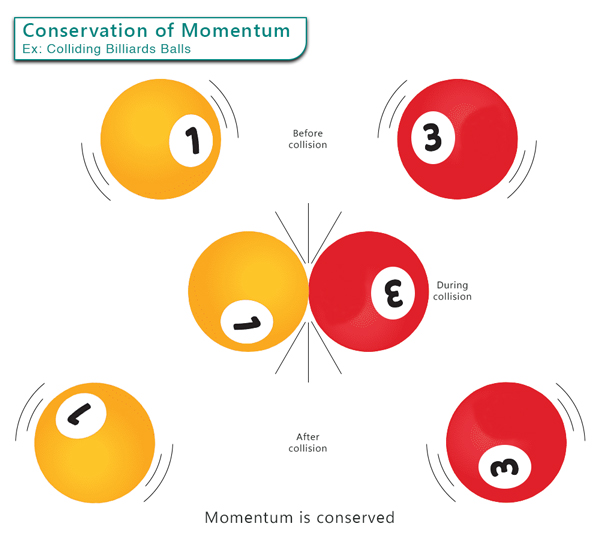
The total momentum of the system, similar to energy, is the sum of the momenta of the individual parts
\[\sum \vec{p}=\vec{p}_1+\vec{p}_2.\]The momenta of the individual balls only change when they collide and emit a force on each other.
The chnage in momentum due to this force onto ball 1 will be given by,
\[\vec{J}_1=\int_{t_i}^{t_f}\vec{F}_{21}\ dt\]Then, due to Newton's third law, we know that the force which ball 1 exerts onto ball 2 will be equal in magnitude and opposite in direction. Which lets us find that
\[\vec{J}_2=\int_{t_i}^{t_f}\vec{F}_{12} \ dt=-\int_{t_i}^{t_f}\vec{F}_{21} \ dt=-\vec{J}_1\]Using this, we can find that the change of momentum of the 2-ball system will be given by
\[\Delta \sum \vec{p}=\sum \vec{J}=\vec{J}_1+\vec{J}_2=0\]From the equation above, we can find that the momenta of a 2 particle system does not change under collisions. This is the conservation of momentum.
Using this, we can make some very nice predictions when playing snookers/billiards. Let's try to applying our conservation laws on billiards.
Billiards
Consider a game of billiards, the objective here is to use the cueball to knock the 8 ball into the hole after getting all the other balls in.
We are at our last ball, the 8 ball. We want to get it into the hole but we are worried that the cueball might also end up in a hole. If this happens, we will be given an automatic loss.
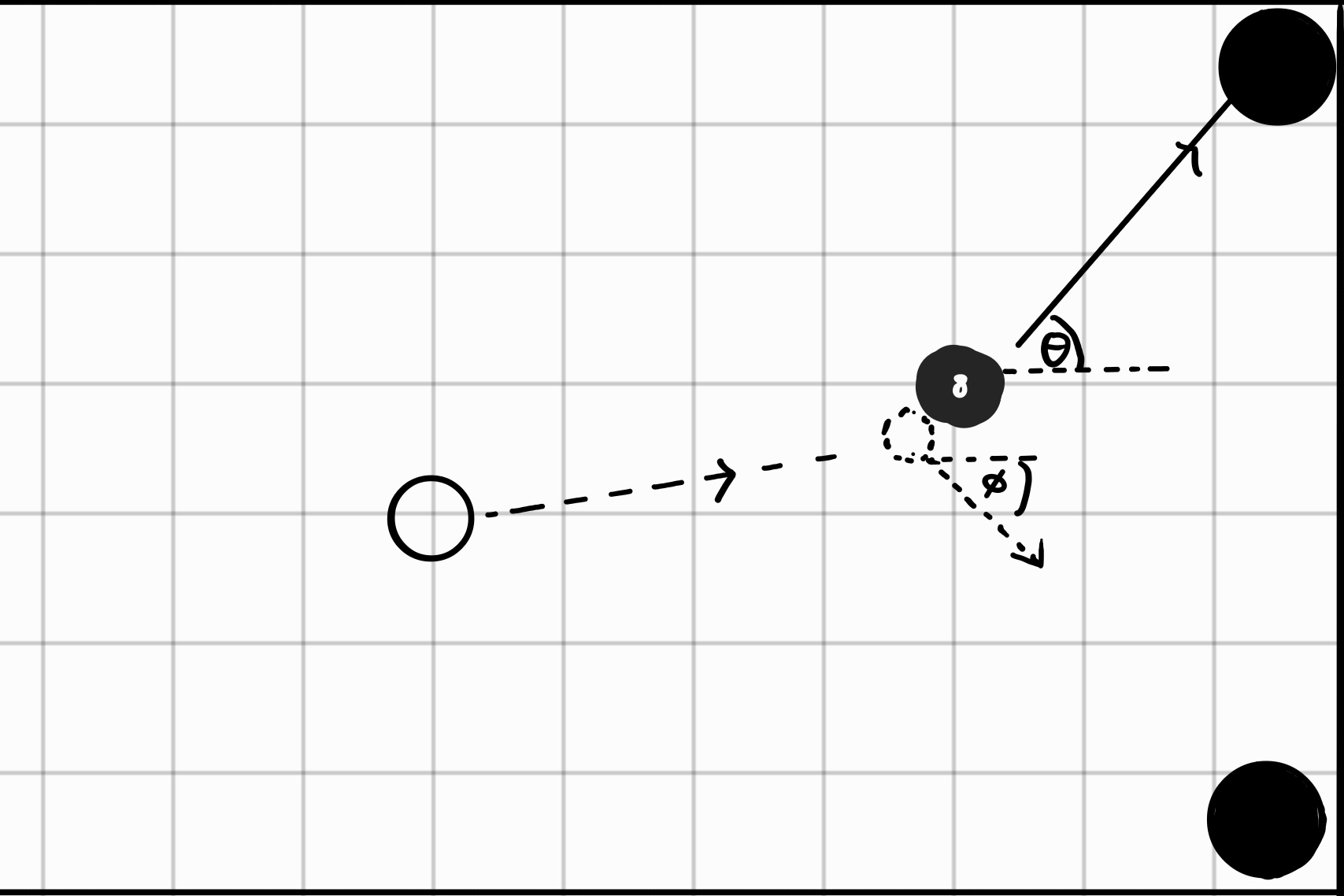
The coordinates of the balls and holes are given by,
\[\vec{r}_{cue}=(0,0)^T,\ \vec{r}_{8}=(0.4,0.1)^T,\ \vec{r}_{hole}=(0.65,0.45)^T\]Where all these units are given in meters.
We will assume that there will be a frictional force which makes the ball decelerate at the rate of \(a=\mu_k g\).
Our objective is to find the minimum velocity which the cue-ball is required to collide with the 8-ball with becuase if we launch the cueball with too much force it might travel to a hole and we don't want to risk that happening.
This collision will be what we call an elastic collision. In here, there will be no loss in energy during the collision.
We will start by first finding the relationship between \(\phi\) and \(\theta\). To do so, we will list down the conservation of energy equation and momentum conservation equations for the x and y axis.
\[\frac{p_i^2}{2m}=\frac{p_c^2}{2m}+\frac{p_8^2}{2m}\] \[\frac{1}{\sqrt{17}}p_i=p_8 \sin(\theta)-p_c \sin(\phi)\] \[\frac{4}{\sqrt{17}}p_i=p_8 \cos(\theta)+p_c \cos(\phi)\]Where \(p_i,\ p_8\) and \(p_c\) are the momentum of the cueball right before collision, the 8ball's final momentum and the cueball's final momentum respectively.
Summing the squares of the 2nd and 3rd equation then lets us get a new equation,
\[p_i^2=p_c^2+p_8^2+2p_8 p_c (\cos(\phi)\cos(\theta)-\sin(\phi)\sin(\theta)).\]Applying the conservation of energy and using some trigonometry lets us find that,
\[\cos(\phi+\theta)=0.\]Solving this tells us that the 2 balls must be deflected in parpendicular direction, in this case, \(90\) degrees apart.
Additionally, take notice to how the displacement of between the 8ball and the hole requires that the angle \(\theta\) is \(45^\circ\)
Now that we know what the angle between 2 of the momenta are and what \(\theta=45^\circ\), we can sub all the angles back into the momentum conservation equation to find that,
\[\frac{4\sqrt{2}}{\sqrt{17}}p_i=p_8+p_c\] \[\frac{\sqrt{2}}{\sqrt{17}}p_i=p_8-p_c.\]Solving for the momentum of the 8ball lets us find a relationship between \(p_i\) and \(p_8\),
\[\frac{5}{\sqrt{34}}p_i=p_8.\]Now, we will look for the minimum velocity after collision required for the 8ball to fall into the hole. We will assume that the ball is required to go to \(\vec{r}_{hole}\).
To do so, we can pull a result from our work kinetic theorem we have found previously, we found that required velocity to travel a distance along a ground with friction coefficiton of \(\mu_k\) is given by
\[v=\sqrt(\mu_k g s)\]Where \(s\) is the distance travelled along the ground. The distance that the 8ball will need to travel is \(|\vec{r}_{hole}-\vec{r}_{8}|=\sqrt{0.185} \ m\). We can round off \(g\) to 10 and most pool tables have a frictional coefficient of \(\mu_k=0.2\). So now we can approximate the required minimum required speed of the 8ball to be
\[v_8\approx \sqrt{0.37}.\]Now, using the relationship between the cueball's momentum right before collision and the 8ball's momentum and making use of the fact that they have equal masses, we find that the minimum velocity to launch the cueball is
\[v_i\approx 2m/s.\]Finally, we just need to relate the velocities of the cueball right after being launched and before colliding with the 8ball.
Using kinematical equations, we get,
\[v_{launch}^2+2as=v_i\]Solving for \(v_{launch}\) lets us approimate the minimum velocity which we launch the ball to be
\[v_{launch}\approx 2.1\ \text{m/s}.\]Remember this the next time you end up playing billiard.
The previous statement was a joke. Although the calculations and equations seem right, take notice to how the frictional coefficient was used completely wrongly. The kinetic friction should only affect objects sliding on the ground. Since our ball would roll on the ground, this would not actually work in a real life setting.
now, after having a feel for using the kinematical momentum equations, let's go back to talking about what momentum generally is.
Momentum, more generally
Most physics textboks would end the section on momentum there, although what we can now understand collisions in physics, this is not where it's story truly ends.
Remember what our motivation behind finding momentum was. We wanted to find quantities in physics that were conserved. Momentum is usually a conserved quantity associated with a certain coordinate in a closed system.
To continue talking about momentum as a more broad and general concept, we have to introduce this concept of a Generator.
Generators
Due to the limitations of the mathematics we've seen here, I will not be able to explain what a mathematical generator truly is. If we wanted to do so, we'd have to talk about Lie algebra.
Lie algebra is the study of symmetries or conservations. It's a subset of abstract algebra and is essentially the mix of differential geometry and group theory. It is not very easy and intuitive so I will be ommiting it for now.
Momentum, generator of translations.
To understand this, we must first think, if we have a system of particles that may clash to each other, what information do we need about the particles to fully know how our system may evolve overtime?
Some good picks may be the position of each particle, the mass of each particle and the velocities of each particle (\(\vec{x}_i, m_i, \vec{v}_i\)). But what if we wanted to be more efficient by using less variables?
Instead of using both the mass of a particle and velocity of a particle, we can combine them into 1 variable, momentum, and say that all that is needed to describe a state of multiple particles would be their position and momenta (\(\vec{x}_i,\vec{p}_i)\).
The main reason we use momentum is because when objects interact with each other, they emit forces which directly affect an object's momentum.
Forces are very much physical, one cannot exactly have physics unless we have forces. Otherwise, the study of physics would just devolve into the study of just motion.
Instead of saying that momentum is equal to mass times velocity, we should instead think of momentum in an object being the mechanism which allows the position of objects to change. More formally, we say that momentum is the generator of translations along coordinates.
A nice way to imagine this would be to think of an object with no momentum. It's clear that the object will not be experiencing spacial translations at all. However, when we add momentum to the mix, the object can start moving, giving it the ability to perform position translations (move).
Angular momentum, the generator of rotations
We've (somewhat) understood that momentum will be used to generate the changes of a system's coordinates. Earlier we've been using cartesian coordinates (\(x,y\)) to derive our usual kinematical momentum (\(\vec{p}\)), what if we tried to use polar coordinates (\(r,\theta\)) to derive some momentum that follows a conservation law as well?
To find kinematical momentum, we decided to use the integral of force over a period of time
\[\Delta \vec{p}_1=\int_{t_i}^{t_f}\vec{F}_{21}\ dt.\]What if we tried to do something similar to the angular counterpart? After all, the work done by torque can also be given by the integral,
\[W=\int \tau \ d\theta.\]This implies that some other conserved quantity can be obtained by integrating the torque over a period of time as well,
\[\Delta L=\int \tau \ dt.\]The new quantity \(L\) here is what we call the angular momentum of a rotating object.
Using the same aruments as I have for the kinematical momentum, we can find that the angular momentum of a spinning object is given by,
\[L=I\omega.\]Now we want to find how it's actually conserved. There are 2 ways to do so.
The first way we can see the coservation is by looking back into the angular counterpart of Newton's third law.
Consider a rotating tray, similar to the ones you see in chinese restaurants.
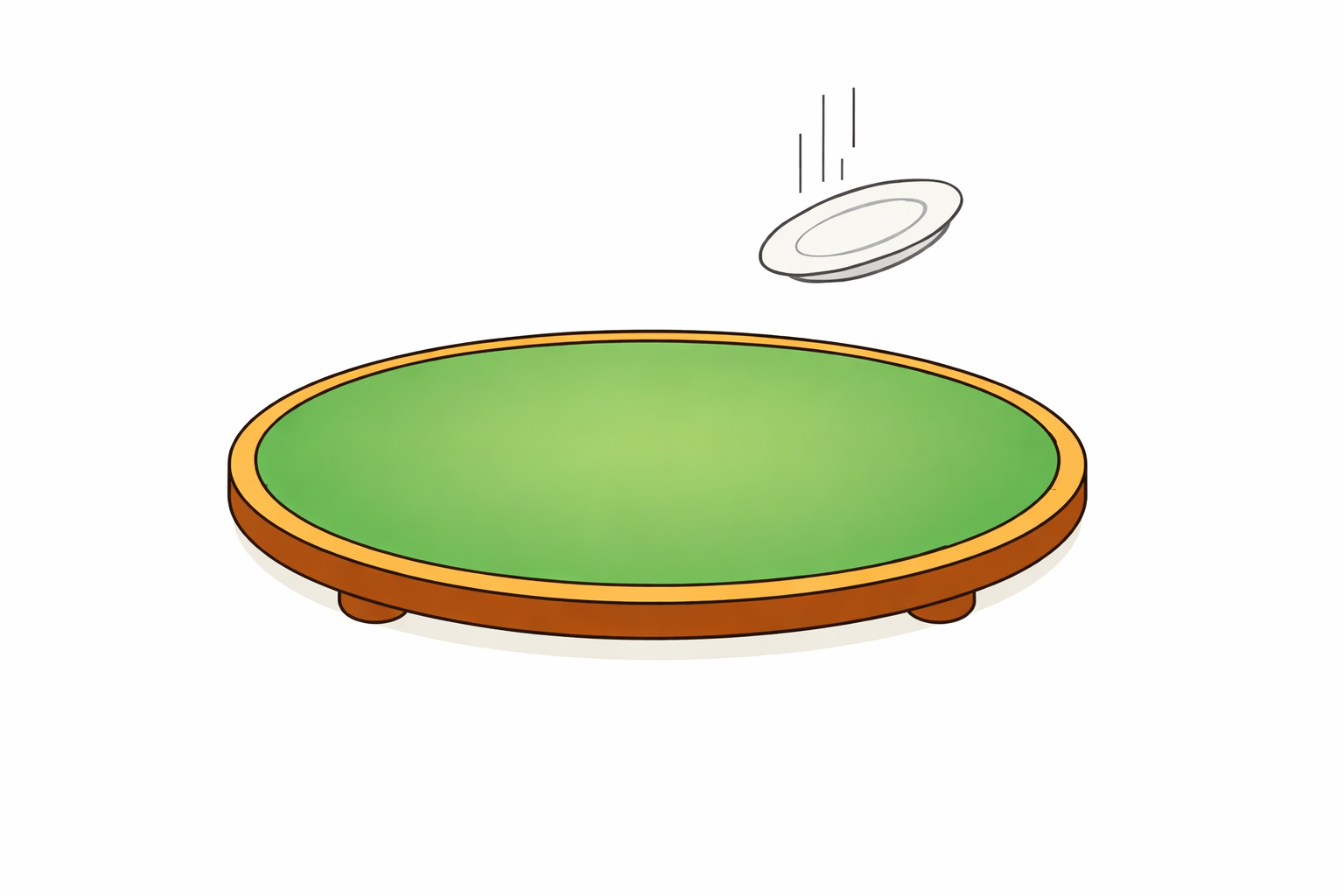
Let's say that this tray is rotating with angular velocity \(\omega\) and has moment of intertia \(I\). What do we think happens if we drop a plate with extra mass at distance \(r\) from the center of the table on it?
It'll problably slow down a bit, how much it'll slow down depends on the angular momentum of the table. If we were to drop a plate onto the table, assuming that the plate does not slip along the table, there will be some frictional force which will cause some impulse \(J\) onto the plate. This friction will also be released back onto the rotating tray due to Newton's third law and cause a short burst of torque \(\tau\) on the rotating tray for a short period of time \(\delta t\).
The change in angular momentum of the table cause by the friction between the plate and table,
\[\Delta L=-\tau \delta t=-(F_f \delta t) r.\]The initial angular momentum of the table will be given by,
\[L_{initial}=I \omega.\]After the plate has been dropped to the table, we can see that it will rotate along with the table, the angular momentum of this plate will be given by:
\[L_{plate}=mr^2 \omega=m \vec{r}\times \vec{v}=|\vec{r}\times \vec{J}|.\]Explanding the impulse using the frictional force, we can find that the angular momentum of the plate becomes,
\[L_{plate}=(F_f \delta t) r\]Summing the angular momenta of the plate and the table's tray, we can find that:
\[L_{final}=L_{table}+L_{plate}=\overbrace{I \omega-(F_f \delta t) r}^{table}+\overbrace{(F_f \delta t) r}^{plate}=I\omega=L_{initial}.\]This is just one way to think about angular momentum conservation. This type of conservation is similar to what we've seen in the kinematical momentum conservation. It arises due to Newton's third law.
What makes angular momentum so special is the other type of conservation.
We've all had our first experience with office chairs, spinning and playing around.
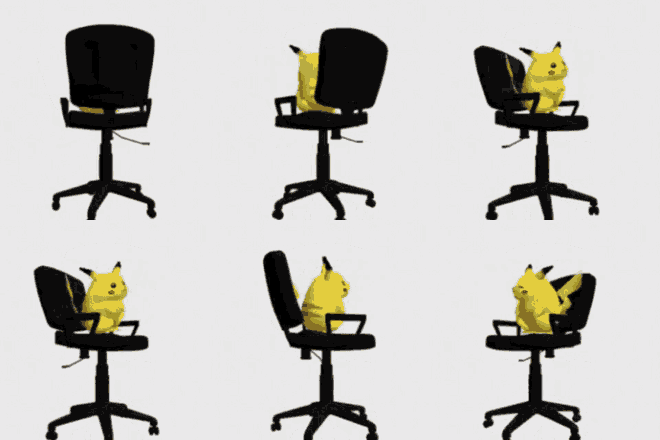
When we spin on the chair, it's well known that we have some angular momentum given by:
\[L=I\omega\]Where \(I\) here depends on how our mass on the chair is distributed. It can increase and decrease if we leave our arms outsreched and pull them in.
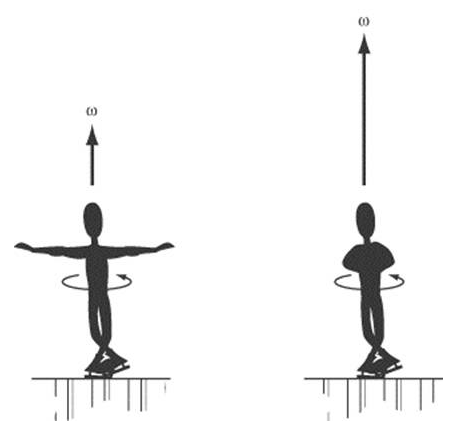
You can try this now! Spin on an office chair with your arms outstreched, then pull them in. You'll find that you end up speeding up.
How much do we speed up tough, can be determined by the angular momentum. We'll find that due to the conservation of angular momentum the final and initial angular momenta of you and the chair will be given by,
\[ L=I_i \omega_i=I_f \omega_f .\]But why is it actually conserved in this case?
This is because pulling your arms in doesn't cause any torque on the system (the chair and you). Remember that we defined angular momentum by taking the integral of torque.
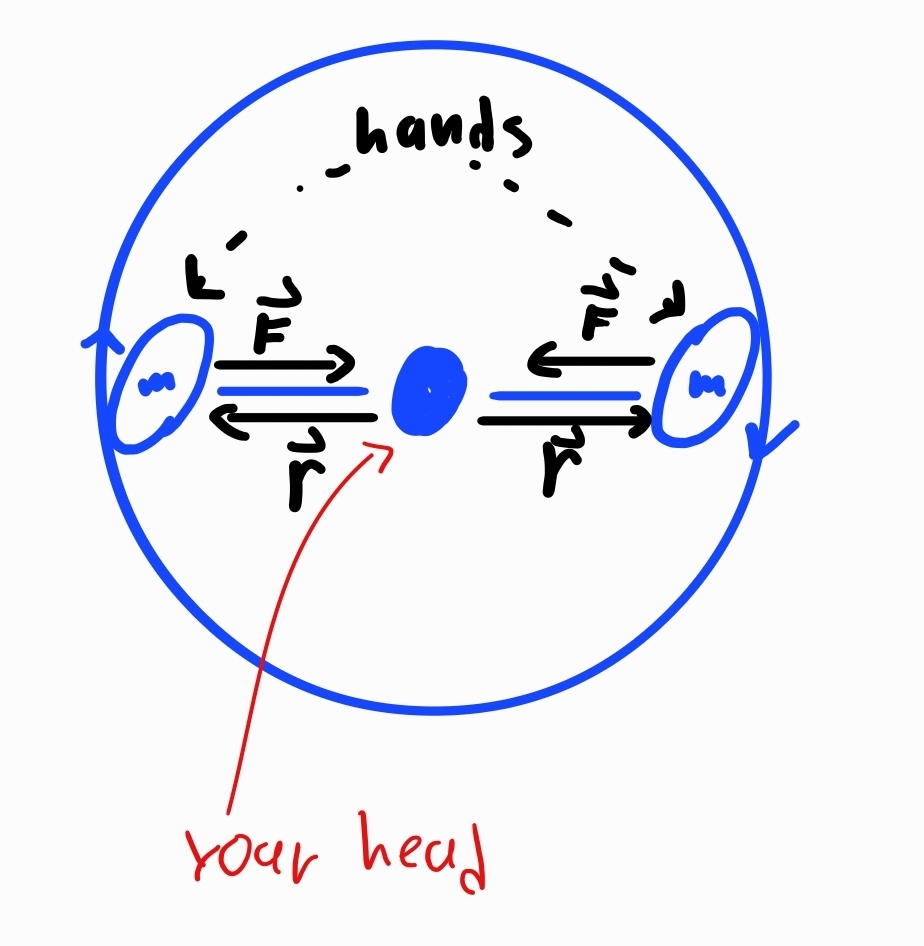
If we were to assume the mass of this sytem comes from your hands (even though it isn't), we can see that the only force you can exert onto it will be parallel to the dispacement of the hands from the axis of rotation. Hence, we'll find that if there were to be some change in angular momentum, it would be given by,
\[\Delta L=\int \tau \ dt= \int \vec{r}\times \vec{F}\ dt=0.\]Which indicates that if we were to try pulling our hands in while spinning, the angular momentum of the system would not change.
Energy, the generator of time evolution.
This would be the last of the basic meaningful generators that we'll show here. So far, we've seen how momentum generates translations and how angular momentum generates rotations along with how all these different generators can be conserved.
While we could see how the 2 momenta there were generators of position translation because of the velocity terms in their definition, the intuition for this type of generator will be a bit different compared to the momenta.
To try to imagine a closed system, completely stationaty, there is no energy whatsoever (both kinetic and potential).
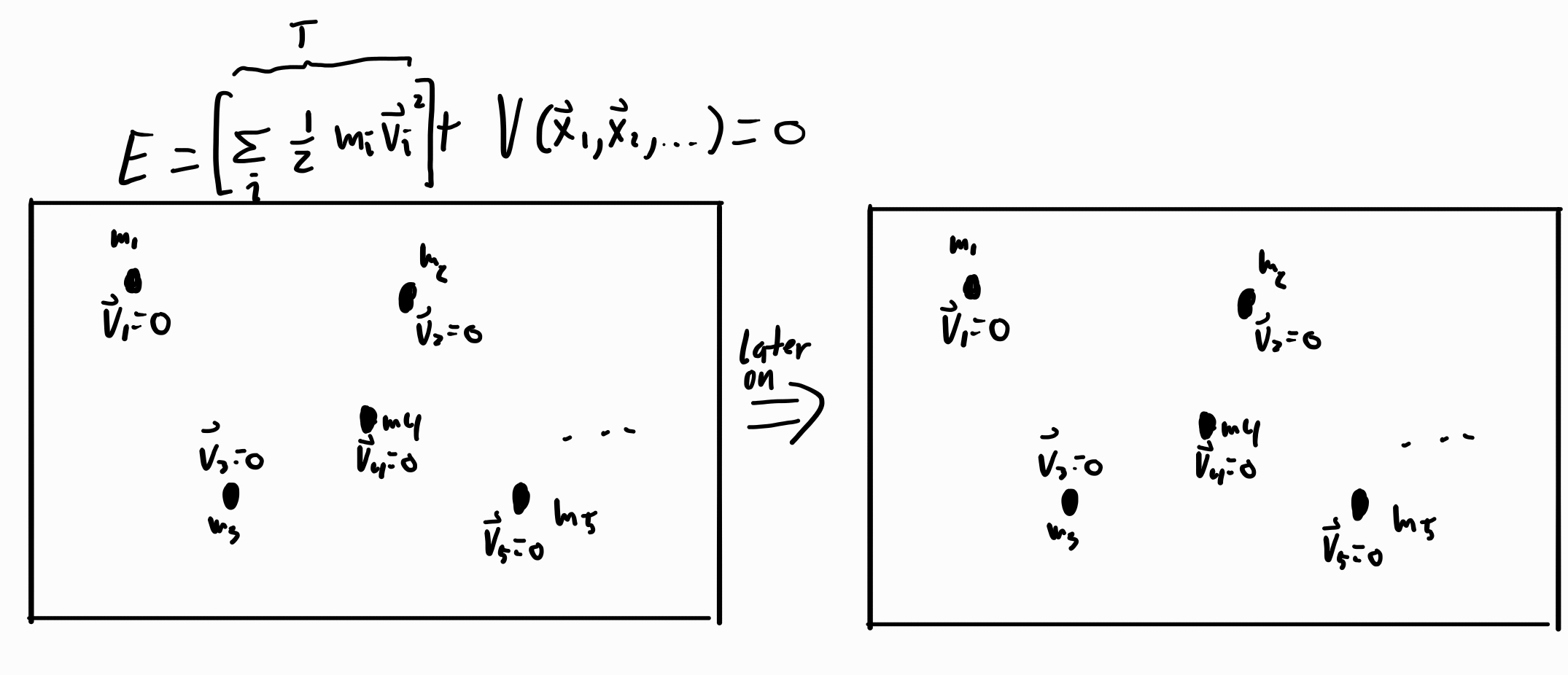
Let's investigate what happens to this system as time passes
No kinetic energy
The fact that there is no kinetic energy implies that the system will not move due to an existing set of velocities from each of the balls.
This is because the kinetic energy of a system would be given by
\[T=\sum_i \frac{1}{2}m_i \vec{v_i}^2\]If the kinetic energy of the system were to be zero, then a combination of the following must happen:
- Masses are zero, this means that part of the system just doesn't exist. Which already tells us nothing will ever happen to that part of the system (no time evolution) as it is empty.
- Velocities are zero, this tells us that the objects are stationary. Meaning that there is no movement, hence, the system in time \(t\) and time \(t+\delta t\) will be identical (to first order in \(\delta t\) ), implying that the system does not evolve instantaneously.
No potential energy
If we just stopped at the \(0\) kinetic energy condition, the objects would still be able to attract and repel each other due to the potential energy (may be electrostatic, gravitational or other potentials), causing motion and change of the system. The potential energy of a system includes information about how the system interacts with "fields" or how forces on the system will work.
Recall that the force on an object due to some potential energy of the object is given by,
\[\vec{F}=-\vec{\nabla}V(\vec{x}).\]It can be seen that if the potential energy of a system were just \(0\), then the force on any part of the system would also just be zero as well.
This, along with Newton's 2nd law, tells us that if our system truly had no potential energy at all, then there would be no forces or no acceleration on the system.
No energy at all
If we were to combine the 2 conditions to make the energy of a system truly zero. Then we'll find that the system will never evolve over time.
Using this fact, we can then conclude that for a system to ever experience any change over time, it must have a non-zero energy in the system. Hence, we can say that energy generates time evolution for a physical system.
Later on, when learning classical mechanics or quantum mechanics, this idea of a generator will become more mathematically clear as more sophisticated mathematics will be introduced in those courses.
Noether's theorem, an introduction and preview of classical mechanics
When we talk about momentum the concept of a "symmetry" is very important. This is what creates the conservation laws.
So far, we have managed to derive quantities like momentum and energy which are conserved under some conditions. Those conditions are the "physical symmetries" of the system.
How I managed to find them is by using what we call Noether's theorem in secret. The theorem states that:
To every continuous symmetry generated by local actions there corresponds a conserved current and vice versa.
This was developed by Amalie Emmy Noether, a german mathematician who worked in a time where academic positions were rare for women.
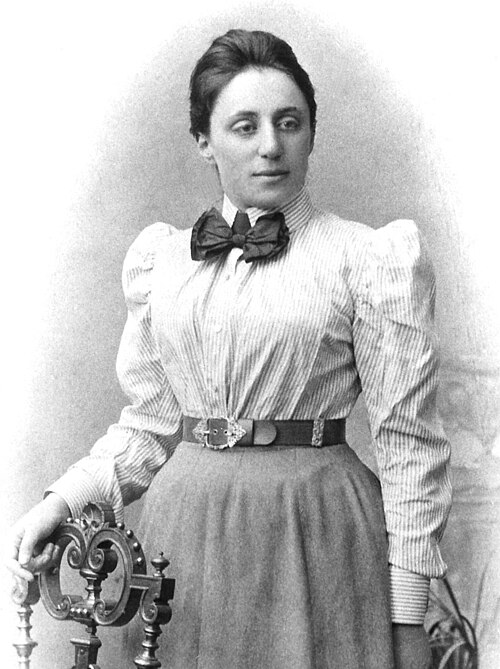
The definition of Noether's theorem may seem to be a bit complicated, but the only new thing we have to know here would be what the "action" is.
For now, all that we have to know, is that the action of a system over a period of time is defined to be the integral:
\[\mathcal{A}=\int_{t_i}^{t_f} L(q,\dot{q})\ dt\]Where the \(L\) here is what we call the "Lagrangian" of a system which physically can always take the form of kinetic minus potential energy,
\[L(q,\dot{q})=T-V.\]Where \(q\) is some coordinate (can be x,y,x or polar) and the dot on top represents the time derivative of that quantity.
All that it is saying is, if we can make some coordinate transform, like (\(x\mapsto x+\delta x\)) without changing the action, then there is some conserved value associated with that "symmetry" transform.
Let's take the conservation of energy for example. This can help with understanding how energy generates time evolution.
Noether's theorem example, conservation of energy.
Consider the Lagrangian,
\[L(x,\dot{x},t)=\frac{1}{2}m \dot{x}^2-V(x).\]This is the usual kinetic minus potential energy we are familiar with. If we wanted to rewrite Newton's second law with this, we could say that,
\[\frac{d}{dt} \left(\frac{\partial L}{\partial \dot{x}}\right)-\frac{\partial L}{\partial x}=0.\] Let's see why. If we expand the first term, we find that \[\frac{d}{dt}\left(\frac{\partial L}{\partial \dot{x}}\right )=\frac{d}{dt}(m\dot{x})=m\ddot{x}=ma.\]The second term then can be expanded as:
\[\frac{\partial L}{\partial x}=-\frac{\partial V}{\partial x}=F_x.\]Where \(F_x\) is the force along x. Then fully expanding lets us find that the equation reduces to,
\[ma-F_x=0.\]Which is just Newton's second law.
From the form of the Lagrangian, we can see that the action of this Lagrangian will not change if we make some transform in time, \(t \mapsto t+\delta t\) as,
\[L(x,\dot{x},t)=L(x,\dot{x},t+\delta t)=\frac{1}{2}m \dot{x}^2-V(x).\]Using this, we can find that if we were to make some change in the time by \(\delta t\) it shouldn't change the action. As the action shouldn't change under this time transform, we must find that,
\[\delta S=\int \delta L \ dt=0\]Using the chain rule, we can find that the change in L due to the time change alone can be expressed as,
\[\delta L=\frac{\partial L}{\partial t}\delta t=\left(\frac{dL}{dt}-\frac{\partial L}{\partial x}\dot{x}-\frac{\partial L}{\partial \dot{x}}\ddot{x}\right) \delta t\]So now, we find that for any arbitrary \(\delta t\) we must find that
\[\delta \mathcal{A}=0=\int \left(\frac{d L}{d t}-\frac{\partial L}{\partial x}\dot{x}-\frac{\partial L}{\partial \dot{x}}\ddot{x}\right) \delta t \ dt\]Integrating the term with acceleration by parts lets us find that,
\[\delta \mathcal{A}=\int \left(\frac{d L}{d t}-\frac{\partial L}{\partial x}\dot{x}-\frac{d}{dt}\left( \frac{\partial L}{\partial \dot{x}}\dot{x} \right)+\frac{d}{dt}\left(\frac{\partial L}{\partial \dot{x}}\right )\dot{x}\right) \delta t \ dt\]Applying "Newton's second law" written with the Lagrangian simplifies the above equation into,
\[\int \left(\frac{d L}{d t} - \frac{d}{dt}\left( \frac{\partial L}{\partial \dot{x}}\dot{x} \right)\right) \delta t \ dt .\]As the change in action must be zero, we find that the integral,
\[\int \frac{d }{d t}\left(L - \frac{\partial L}{\partial \dot{x}}\dot{x} \right) \delta t \ dt ,\]must then also always be zero for any arbitrary \(\delta t\). Which indicates that
\[\frac{d }{d t}\left(L - \frac{\partial L}{\partial \dot{x}}\dot{x} \right)=0.\]Equivalently, we can also say that,
\[\frac{d }{d t}\left( \frac{\partial L}{\partial \dot{x}}\dot{x}- L \right)=0.\]Or, we can also say that,
\[\frac{\partial L}{\partial \dot{x}}\dot{x}- L =\frac{1}{2}m \dot{x}^2+V(x)=E=const.\]This indicates that the conserved quanity due to time translation symmetry is the energy. The fact that this is true is very very closely related to how energy is the generator of time evolution of a system.
Wow, that seemed to be a really tough concept to try to understand. Don't worry though, I have added this extra section on Noether's theorem in order to ease us into the study of symmetries and more advanced mechanics. This is just a taste of what classical mechanics (the next course if you don't jump to quantum mechanics) has in store for us.
Wrapping up
In this course, we have seen how to look at the motion of objects, how forces work and looked into hints of the symmetries and conservations which the universe holds for us in the energy and momentum sections.
I hope to be seeing you again in the next course whether it be the continuation to classical mechanics or the Quantum mechanics course. The choice between the 2 is your decision to make.