Let's start with the big question:
What is energy?
It seems to be quite an abstract concept. Just something that can be transferred and have it's form changed, like heat electrical to heat energy or to motion which we see in our daily lives when we use heaters, fans or the light bulb in our rooms.
Although that seems like a nice meaning to have in our head, we need something more definite. In physics, we define energy of an object to be the capacity for something to output work.
Ok, that's neat. The next question then becomes, what is work? A nice general concept to have in mind, is that mechanical work must be related to how much force we output onto another object.
It's like having to lift weights, we know that lifting heavier weight requires more force, therefore more work as well. Something you also notice is that when you move less in weight lifting, you tend to use less effort and less work. This also indicate that the amount of distance you exert a force along also changes the amount of work required.
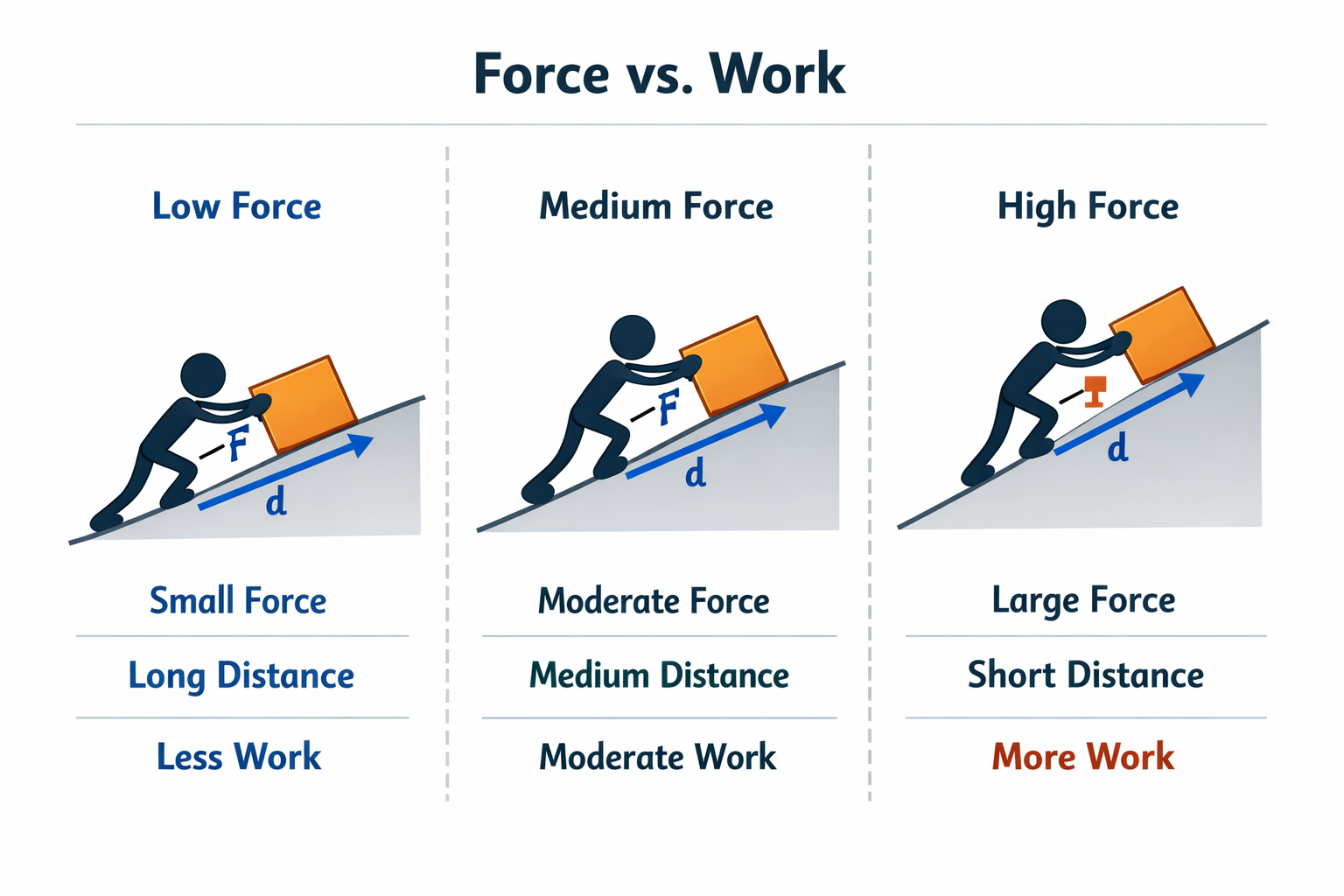
This seems intuitive enough for now. But this is really just handwaving. We still don't exactly know how exactly this is related to energy, so let's proceed by deriving the work kinetic theorem.
Work and kinetic energy
Before we get straight to deriving the what we call the work kinetic theorem. We'll first come back to kinematics. So far, we've made use of the relation between position and time derivatives to derive an equation for an object under constant acceleration:
\[\vec{s}=\vec{v}t+\frac{1}{2}\vec{a}t^2\]Let's try to use a neat little trick to derive another interesting equation. We are familiar with the equation,
\[\vec{a}=\frac{d\vec{v}}{dt}\]Taking the dot product of both sides with velocity gives
\[\vec{a} \cdot \vec{v} = \frac{d\vec{v}}{dt} \cdot \vec{v}\]Using the fact that since \(v\) is a function of \(t\) and the product rule, we find that
\[\frac{d\vec{v}^2}{dt}=2\frac{d\vec{v}}{dt}\cdot \vec{v} .\]Making use of this lets us obtain a "new" kinematical equation by integrating both sides with respect to time along the inital and final times
\[\int\vec{a}\cdot \vec{v}dt=\int\frac{d\vec{v}^2}{dt} dt\]Simplifying and subbing the bounds gives us the following
\[\vec{v}^2=\vec{u}^2+2\vec{a}\cdot\vec{s}\]Where \(\vec{s}\) is the displacement between the initial and final times.
Ok, that's a nice equation. But what does it have to do with energy you may ask. If we multiply both sides of the equation by the mass of an object, apply Newton's second law and rearrange, we find that we end up getting an interesting equation that says:
\[\frac{1}{2}m \vec{v}_f^2-\frac{1}{2}m \vec{v}_i^2=\vec{F}\cdot \vec{s}.\]The expression here turns out to be a very handy one we tend to use a lot. So we decided to label the terms here kinetic energy \(T=\frac{1}{2}m v^2\) and work done \(W\)
We call \(T\) kinetic energy as it increases as the magnitude of an object's velocity increases, it is the energy of motion, hence the name "kinetic". This expression is always true for all object smoving with some linear velocity \(\vec{v}\), we will also see that we'll make some interesting findings when looking at it's angular counterpart.
Keep in mind that the equation \(v^2=u^2+2\vec{a}\cdot\vec{s}\) only works under constant acceleration. Because of this we cannot always say that the work done by some force is given by
\[W=\vec{F}\cdot \vec{s}.\]The equation above is true under the circumstances where the force is constant, like local gravitational force which just gives an object a force (weight) of \(\vec{F}=mg\) downwards everywhere. When we don't have a constant force, like if someone were to push an object along a path, we like to add little increments of \(\vec{F}\cdot\vec{ds}\) to form the integral
\[\int_c\vec{F}\cdot\vec{ds}\]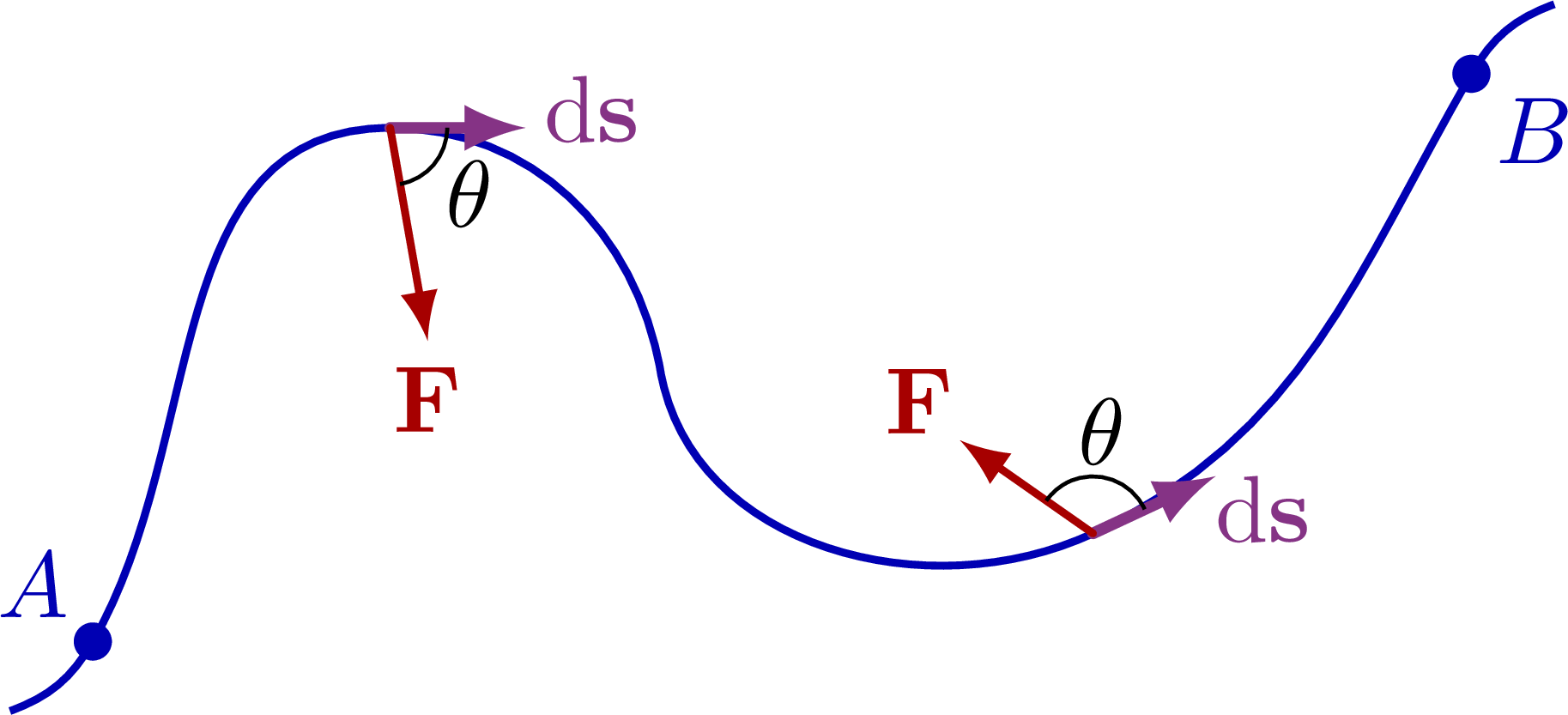
This here looks like an odd integral, it doesn't look like an ordinary integral where we just perform the usual antiderivative or 2 of them. This is called a line integral and it is part of what we call vector calculus. I won't go too deep into vector calculus, but I'll show you how an integral like this can be evaluated and what the letter \(c\) at the integral means.
One last thing before the problem. The relationship between work done and kinetic energy is given by what we call the work kinetic theorem:
\[W=\Delta T=\Delta \left(\frac{1}{2}m \vec{v}^2\right)\]Finding Nemo?
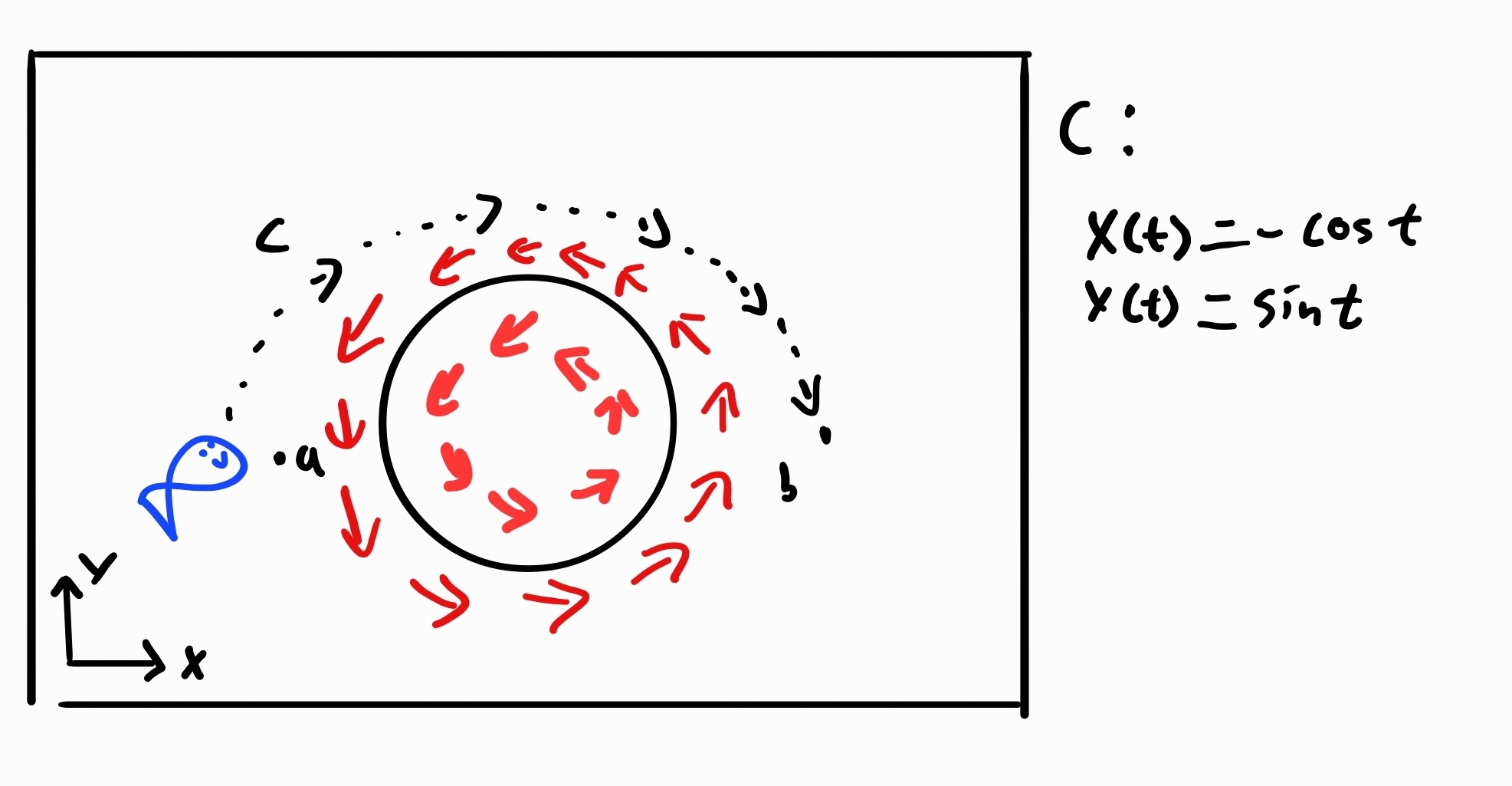
Dory is trying to find Nemo (not affiliated with pixar) but oh no! She stumbles across a vortex and is required to swim around it. She (questionably) chooses to swim around this vortex in a semicircular path given by the trajectory C,
\[C:x(t)=-\cos(t) \ \text{m} ,\ y(t)=\sin(t) \ \text{m} ,\ t\in(0,\pi).\]Where time (\(t\)) is in seconds.
The powerful vortex is modelled by this "vector valued function," which mathematicians like to call vector fields, which will exert a force given by
\[\vec{F}(x,y)=\frac{-y}{\sqrt{x^2+y^2}} \hat{i}+\frac{x}{\sqrt{x^2+y^2}}\hat{j} \ \text{N} .\]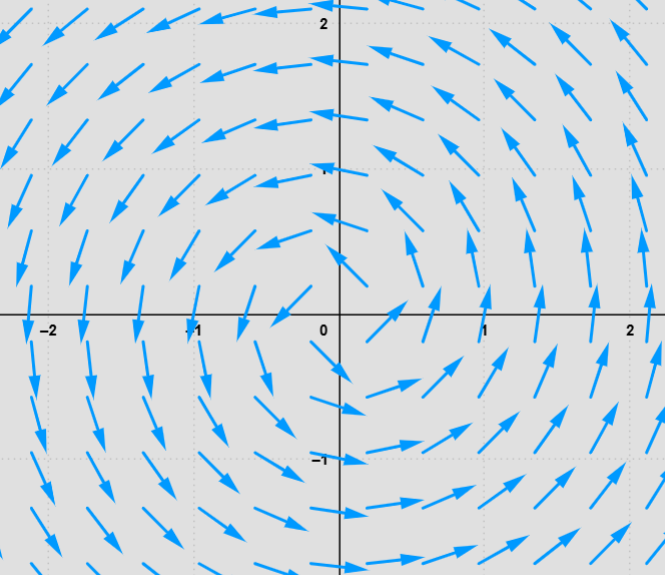
Before deciding to cross this whirlpool, Dory has to think of whether she can output enough work to cross this whirlpool. She is only able to output 5 Joules (SI unit for energy in \(kg\ m^2s^{-2}\)) at the current moment. Should she cross or not?
This seems like a tough decision to make. Thankfully, we've learnt the equation to determine the amount of work done required for this,
\[W=\int_c\vec{F}\cdot\vec{ds}.\]For now, let's assume that our beloved fish, Dory, is massless and we'll also make use of the fact that as \(\vec{s}=x \ \hat{i} +y \ \hat{j}\) to be able to express functions like \(\vec{F}(x(t),y(t))\) as \(\vec{F}(\vec{s}(t))\) which shortens notation. To perform this integral, we can use a nifty trick with the chain rule and say that our integral can be expressed as:
\[ \int_c\vec{F}(\vec{s})\cdot\vec{ds}=\int_0^\pi\vec{F}(\vec{s}(t))\cdot\frac{d\vec{s}}{dt}(t)dt .\]Now, the right hand expression, while daunting, seems to be more familiar than what we saw to the left.
From here, it all becomes a computational matter. We sub in the parameterization given by \(c\) into \(\vec{F}\) and \(\frac{d\vec{s}}{dt}\) to get,
\[ \vec{F}(\vec{s}(t))= \frac{-\sin(t)}{\sqrt{\cos(t)^2+\sin(t)^2}}\ \hat{i}- \frac{\cos(t)}{\sqrt{\cos(t)^2+\sin(t)^2}}\ \hat{j}\] \[=-\sin(t)\ \hat{i}-\cos(t)\ \hat{j},\] \[ \frac{d\vec{s}}{dt}(t)= \sin(t) \ \hat{i}+\cos(t) \hat{j} .\]It seems that we are almost done here. But wait, we'll need to pay attention to the force \(\vec{F}\). What we've been working with is the force which the whirlpool will be exerting onto Dory. Remember, the \(\vec{F}\) in the work integral we want here should be the force which Dory exerts along the path.
To do this, we'll make use of Newton's third law. Since the whirlpool is exerting a force \(-\sin(t)\ \hat{i}-\cos(t)\ \hat{j}\) onto Dory
Dory should be exerting a force equal in magnitude and opposite in direction to that. So now, the force function \(\vec{F}\), should be given by,
\[\vec{F}(t)=\sin(t) \ \hat{i}+\cos(t) \hat{j}.\]Now, evaluating the integral and the dot product gives,
\[W=\int_c\vec{F}(\vec{s})\cdot\vec{ds}=\int_0^\pi\vec{F}(\vec{s}(t))\cdot\frac{d\vec{s}}{dt}(t)dt=\int_0^\pi dt=\pi \approx 3.14 \ J.\]At the end we can safely say that she can cross this whirlpool in the desired path if she wants to.
I still think that she shouldn't do it though. Because it'd be much easier if she just followed the force of the whirlpool.
Back to the work kinetic theorem
Ok, so now we that we've seen how we can perform a "line integral" let's look more into the physics of energy. Earlier, we've mentioned that the work kinetic theorem lets us know that work causes change in kinetic energy, or even better, they're equivalent. Now let's see how kinetic energy shows up in different forms by presenting the work kinetic theorem in different scenarios.
Sliding box problem
Consider an object on a slope, it will slide down along some frictionless curve from height \(h\) into a rough ground with friction \(\mu_k\), we will assume that the object does not roll.
As seen on the applet above, as the ball drops, the kinetic energy of the ball will increase. An explanation for this can be what's called Potential Energy but we'll get there soon. For now, let's use work done and the work kinetic theorem to explain what's going on in the applet.
Let's analyse this applet in 2 different stages:
- The object dropping (we'll find the maximum velocity)
- The object slowing down
Let's first look at what's going on with the kinetic energy as the object drops down the slope.
As the object falls down. We see that there are 2 forces occuring on it. The weight force pulling directly down and the normal force pushing parpendicular to the motion.
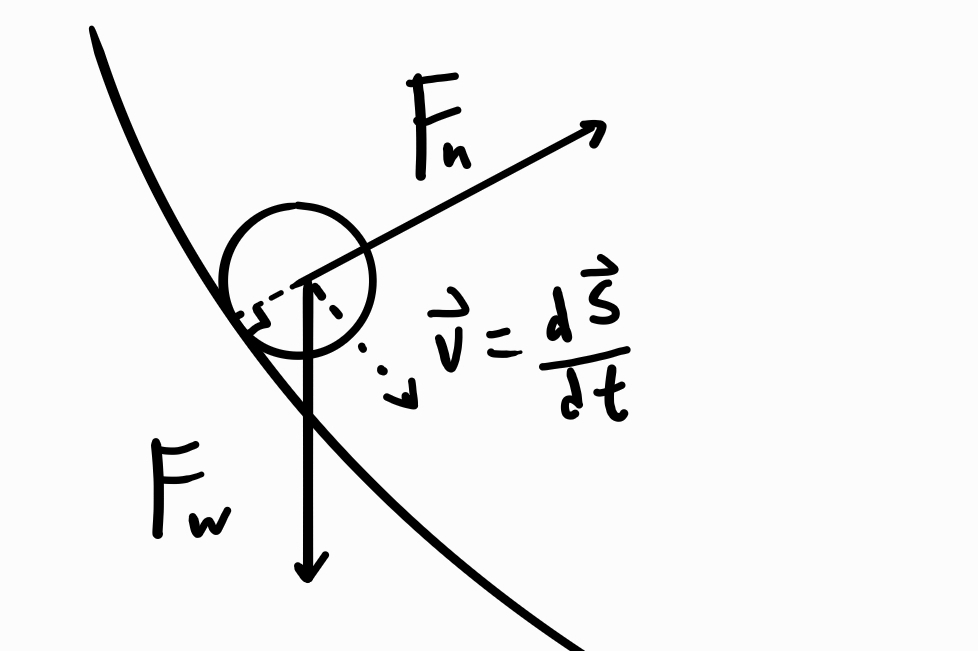
Because the normal force \(\vec{F}_n\) is parpendicular to the motion of the object \(\vec{v}\) and the work done requires force along the motion, we can say that the normal force \(\vec{F}_n\) does no work to the object.
We can now use our little trick where we said that if the force on an object was constant, then the work done can be equated as,
\[W=\vec{F}\cdot \vec{s}.\]As the only force existing is the weight force given by \(\vec{F}_n= -mg\ \hat{j}\) and the displacement of our object along the y axis is given by \(s_y=h\). We can find that the total work done by gravity to object will be given by:
\[W=mgh\]For those of you with some experience in physics, you'll find this to be a very familiar friend. We'll get back to him soon. For now, let's try to find the maximum velocity which the object will move at. Due to the work kinetic theorem, we can say that the following is true
\[mgh=\frac{1}{2}m\vec{v}^2\]Solving for the velocity lets us find that the maximum velocity of the object will be
\[\vec{v}=\sqrt{2gh}\]Now that we've analysed how the object will drop and found it's maximum velocity, let's try to then calculate how far along the ground this object will slide.
After sliding, we can see that the object's kinetic energy will be equal to the amount of work done by the gravity, which we'll call \(W_g\). In order to make the ball stationary again, the friction from the ground must perform work \(W_f\) onto the ball equal to the negative of ball's kinetic energy after sliding as we want
\[T_f=0=T_i+W_f\]Since the initial kinetic energy is equal to the work done by the gravity we can say that we want:
\[W_g+W_f=0=W_{net}\]We havent changed the equation at all, but as you can see, we have changed the meaning of this equation. It now says that we want the total amount of work from the gravitational force and from the frictional force to sum to \(0\).
Why? This is because the initial state of the ball had 0 kinetic energy and we want the final state to also have 0 kinetic energy since we're trying to find the distance travelled before the ball goes stationary (\(T=0\)).
Nice, now we have an equation relating the intermediate state and he final state of the object. Now, since the work done by friction is given by
\[W_f=\overbrace{\vec{F}}_f^{-mg \mu_k \ \hat{i}} \cdot \vec{s}=-mg \mu_k x.\]Where \(x\) is the distance travelled before stopping.
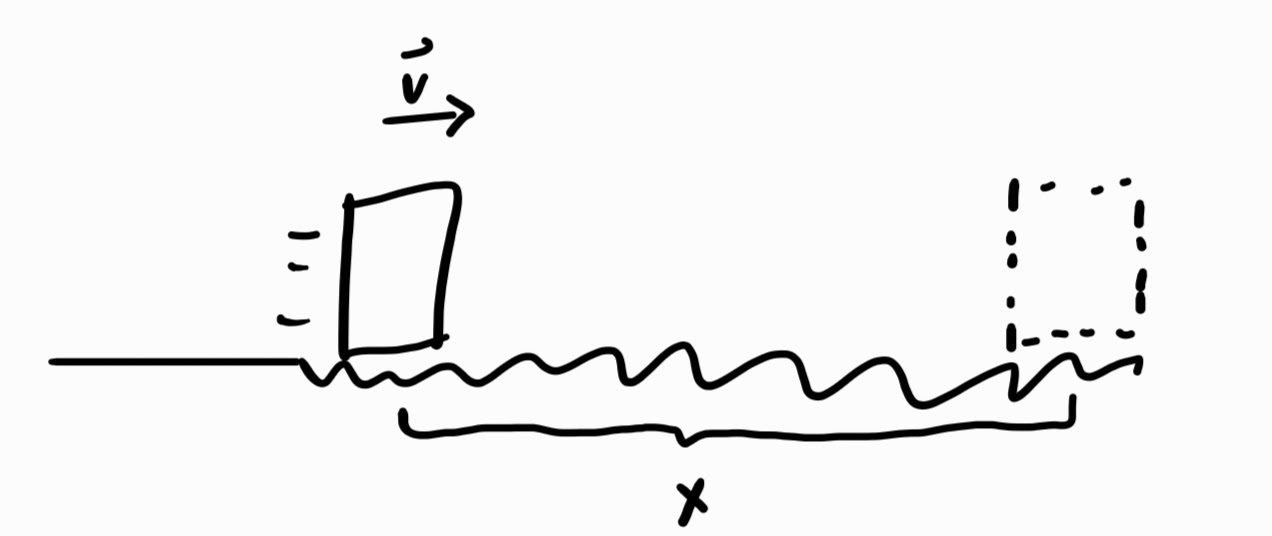
So now plugging into the work equation gives,
\[W_g+W_f=mgh-mg \mu_k x=0.\]Solving for \(x\) lets us find that the distance that the object in the applet will travel along the flat ground will be
\[x=\frac{h}{\mu_k}.\]There it is, analysis of the sysem with work. If you're interested in mechanics experiments, this can be a great start as it's not too hard to set up.
Rotational energy: the yoyo
Consider a yoyo with a string length of \(h\) with mass \(m\) and moment of inertia about its centre of mass \(I\). Its inner and outer radii are \(R_1\) and \(R_2\) respectively.
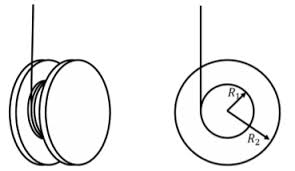
We want to determine how fast the yoyo rotates after it is dropped from the height \(h\). In particular, we seek its angular velocity \(\omega\) just before the string becomes fully unwound.
We approach this problem using energy methods. As the yoyo falls, the work done by gravity turns into kinetic energy. But this kinetic energy isn't just the kinetic energy from translation. We also have to factor in the fact that the yoyo ends up spinning which is a type of energy on it's own. Due to this, we will add what we call rotational kinetic energy \(T_{rot}=\frac{1}{2} I \omega^2\) . The total kinetic energy now can be expressed as : \[T_{tot}=T_{trans}+T_{rot}=\frac{1}{2}mv_{com}^2+\frac{1}{2}I\omega^2,\] Where, \(com\) stands for center of mass.
The gravitational force \(\vec{F} = -mg\,\hat{j}\) does work on the system, which will give the yoyo it's rotational and translational kinetic energy. Let's see why and how these energies will be disributed.
To do so, we will have to draw a free body diagaram of the yo-yo.
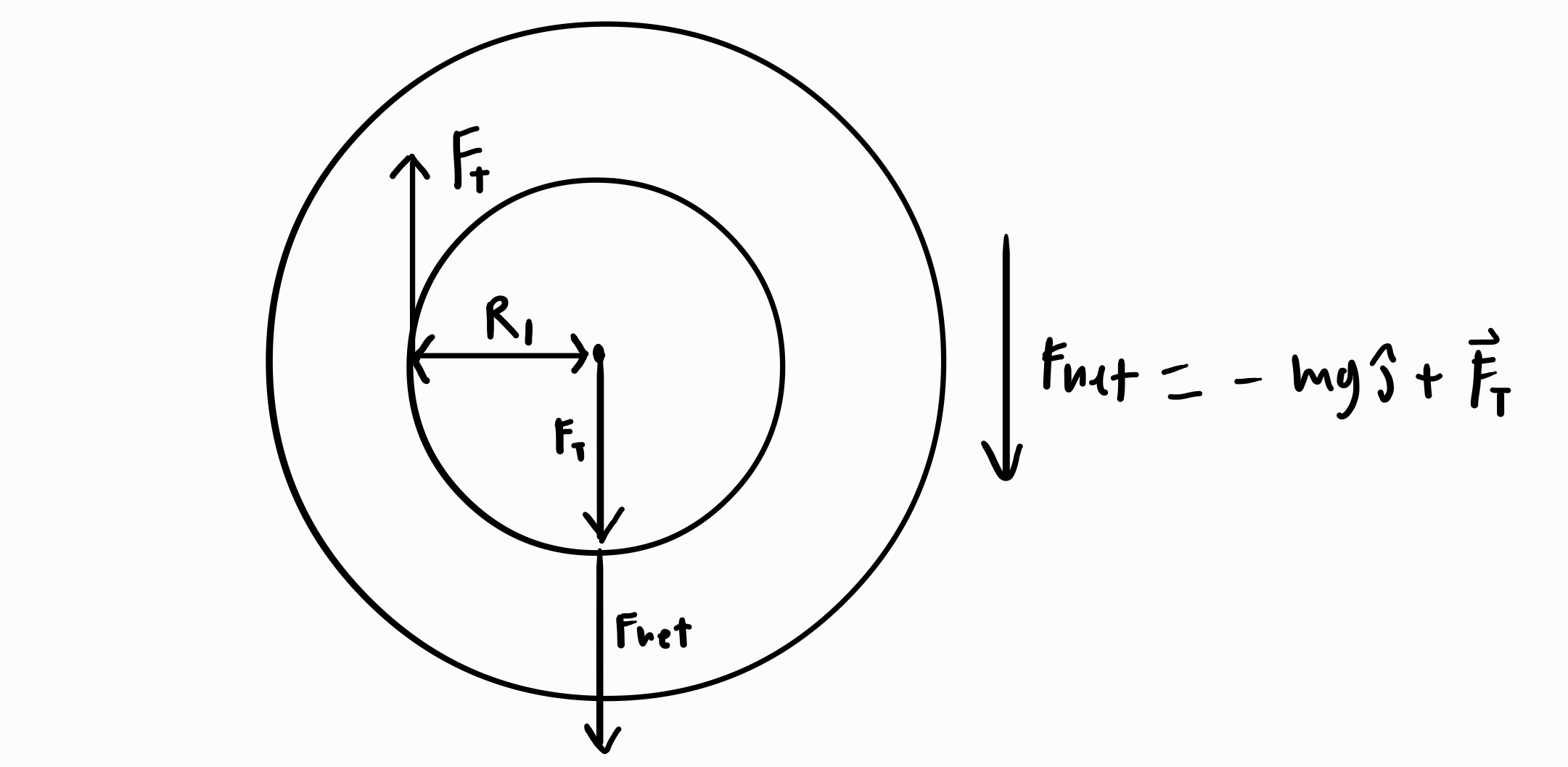
In here, we have seperated the gravitational force into the net force and what engineers call a "couple" using the fact that the only effective forces are tension and gravity, meaning that,
\[\vec{F_{net}}=\vec{F_g}+\vec{F_T},\]or
\[\vec{F_g}=-mg\ \hat{j}=-|\vec{F_T}|\ \hat{j}+\vec{F}_{net}\]The torque couple
We get a couple when we have 2 opposing forces at different positions.
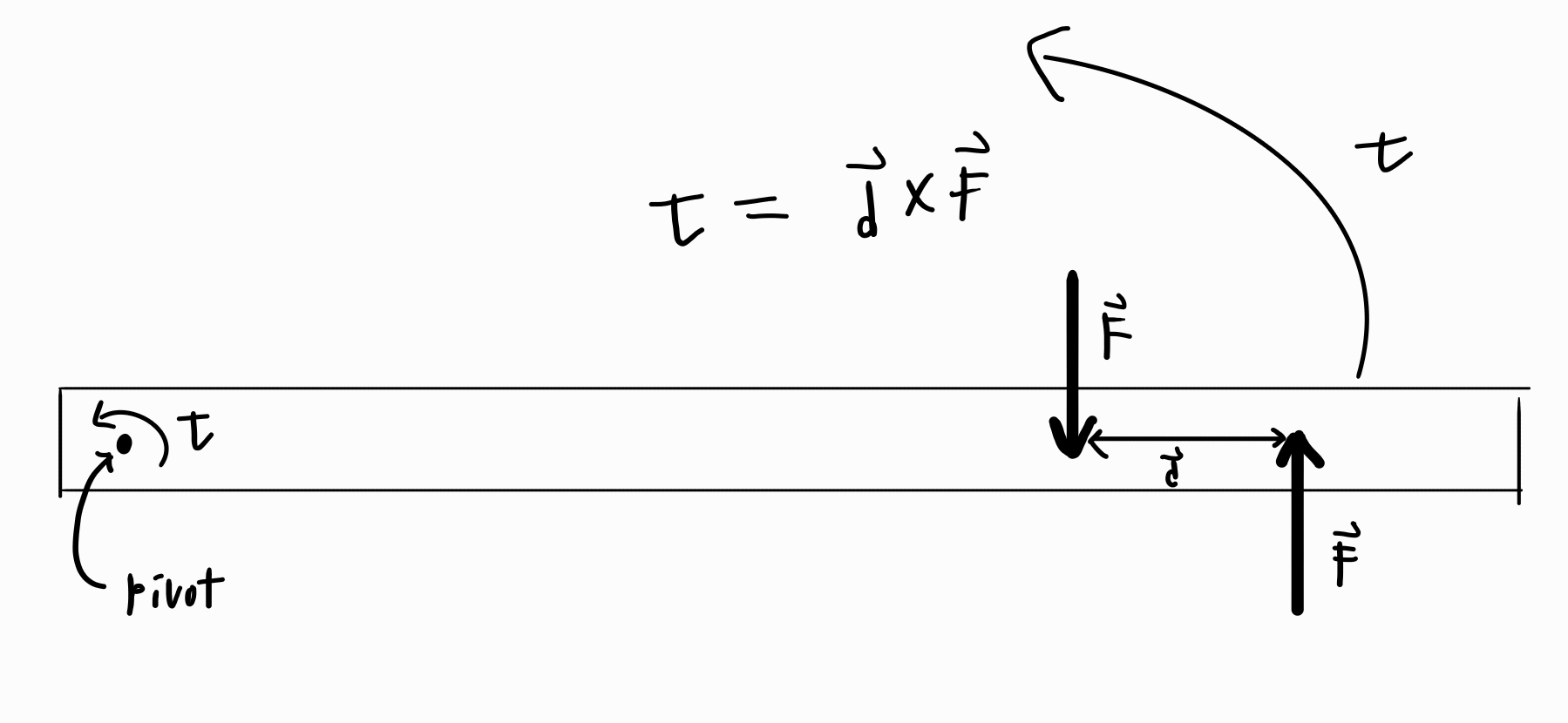
The couple is mathematically given by,
\[\tau=\vec{d}\times \vec{F}.\]Engineers like to use this "couple" to indicate the strength of rotation. What makes it so special is that. Unlike a force on an object with a pivot, a couple always exerts the same torque regardless of where it is positioned.
Additionally, it has the added effect of not causing any net force. Due to this, it always makes an object rotate about it's center of mass regardless of where it is positioned as the center of mass will not move without a non-zero net force.
Using this new info, we can see that there will be work done not only for linear motion with the net force \(\vec{F}_{net}=m \vec{a}\), we will also be having a net torque \(\tau_{net}=I\alpha\).
Now, if we sum the work kinetic theorem equations for both rotation and translation, we find that we get the total work to be
\[W_{tot}=\overbrace{\tau \theta}^{W_{rot}}+\overbrace{\vec{F}_{net} \cdot \vec{s}}^{W_{trans}}=\overbrace{\frac{1}{2}mv_{com}^2+\frac{1}{2}I\omega^2}^{T_{final}}-\overbrace{0}^{T_{initial}}=\Delta T.\]Using the couple which we seperated from the net force earlier, we can find that
\[\tau=I \alpha=F_T\times R_1 .\]Additionally, using Newton's 2nd law, we can find that the following equation is true,
\[\vec{F}_T- mg\ \hat{j} =\vec{F}_{net}.\]Since the displacement is given by \(\vec{s}=-h\ \hat{j}\), we can work out the work done by translation to be,
\[W_{trans}=\vec{F}_{net} \cdot \vec{s}=(mg-|F_T|)h.\]We can also work out the rotational work to be
\[ W_{rot}=\tau \theta=F_T R_1\theta. \]Using the fact that the yoyo is rolling without slipping, we can find the following relations to be true:
- \(|s_{com}|=R_1\theta\)
- \(|v_{com}|=R_1\omega\)
- \(|a_{com}|=R_1\alpha\)
Using relation 1, we can find the total work done to end up being:
\[W_{tot}=mgh\]Hm, that's weird, that same expression, \(mgh\), shown up again. I will explain what this is about soon, but for now please bear with me as I complete this problem.
Now,using relation 2, we can also simplify the total kinetic energy to be
\[T_{tot}=\frac{1}{2}mR_1^2 \omega^2+\frac{1}{2}I \omega^2=\frac{1}{2}(mR_1^2+I)\omega^2\]Plugging this into the work kinetic theorem and using the fact that the initial kinetic energy is \(0\) lets us find that
\[mgh=\Delta T=\overbrace{\frac{1}{2}(mR_1^2+I)\omega^2}^{T_{final}}-\overbrace{0}^{T_{initial}}.\]Solving for the angular velocity at the end gives
\[\omega=\sqrt{\frac{2mgh}{mR_1^2+I}}\]That's the end of the problem, we have found the angular velocity in terms of the known quantities. Now that that's over, let's inspect what's going on with the term \(mgh\) here.
Potential energy
Let's now look into what this \(mgh\) here is. It's shown up a couple times and seems to be a recurring term whenever we have gravity involved.
Due to how frequently this term has shown up in problems, physycists and engineers have decided to call this gravitational Potential Energy. In general, we define the "potential energy" of an object to be the amount of potential work to be done to the object.
We like to call the sum of kinetic energy \((T)\) and potential energy \((V)\) as the total energy of an object.
For example, if we consider the sliding box problem beforehand.
It can be seen that the total work that can be done by gravity alone is given by,
\[\int \vec{F} \cdot d\vec{s}=mgh.\]As the block drops, it can be seen that the potential energy of the object drops and is transferred to the kinetic energy. Additionally, we can see that before the block slides on the ground, the mechanical energy stays constant.
This is true becuase if the potential for work to be done on an object (\(V\)) is dropping, that simply means that it is performing the said work. This also hints on what we call a "conservation law".
In other words, we can say that the work done by an object must be negative of the change of potential energy
\[W=-\Delta V.\]By expanding the work done in terms of forces we can find that if we can model a potential energy from an existing force vector field (\(\vec{F}(\vec{x})\) must be conservative), then we have,
\[-\int_c \vec{F}\cdot d\vec{s}=V(\vec{x_f})-V(\vec{x_i}).\]From here, applying the 2nd fundamental theorem of calculus allows us to find that if we have some potential energy as a function of position, we can find that the force corresponding to the potentia energy as a function of position can be modelled as,
\[\vec{F}=-\vec{\nabla} V(\vec{x}).\]Where \(\vec{\nabla}= \frac{\partial}{\partial x}\ \hat{i} +\frac{\partial}{\partial y}\ \hat{j} +\frac{\partial}{\partial z}\ \hat{k} \) is the 3-d derivative or what mathematicians like to call the "gradient" of a function of multiple variables. The \(\partial\) here means that we are taking what we call "partial derivatives.
Partial derivatives
A partial derivative is similar to the usual derivative we know. The only difference is, when we are dealing with a function of multiple variables, such as \(f(x,y)=x^2+y^2+2xy\). A partial derivative with respect to a variable like \(x\) will treat the other variable as if it were fixed, hence
\[\frac{\partial }{\partial x}(x^2+y^2+2xy)=2x+2y\]If we were using the usual derivative instead, we will treat all variables as if it were related to x, so we instead have,
\[\frac{d}{dx}(x^2+y^2+2xy)=\frac{d}{dx}(x^2+y(x)^2+2xy(x))=2x+2y+\frac{dy}{dx}(2y+2x).\]You may visualize the partial derivatives of a function which takes 2 values below (drag the green dot),
In the applet above, the slope of the red lines will represent the partial derivatives of the function along the axis.
Back to the work kinetic theorem
Applying the work kinetic theorem to the relationship between work and potential energy, we can also say that,
\[\Delta T=-\Delta V.\]When we're talking about work done and potnetial energy, the equation mentioned above (\(W=-\Delta V\)) only works for the potential energy and work corresponding to the same forces.
If we do not take some extrernal force (such as friction) into account in our potential energy, instead of work done simply transferring kinetic into potential energy, the work done by this external force can actually decrease or increase the total energy by directly affecting our total energy.
Using this, we can solve the last 2 problems we had with work much faster than we did the first time.
Sliding block problem (again)
Consider the same sliding block. It will start with the potential energy
\[V=mgh.\]To find the distance that the block will travel on the gorund, we must ask the question, how much work does the the block need to perform onto the ground (via friction) so that the total energy (both kinetic and potential) goes to \(0\)?
That's simple! The total amount of energy which the object starts with can be given by:
\[E=T+V=mgh.\]The kinetic term is zero due to the object being stationary in the object in its initial state.
Now, we can take the work done by the object due to friction as a function of the distance the object travels to be,
\[W=\vec{F}\cdot \Delta\vec{s}=mg \mu_k x.\]Why is it positive this time you may ask, it is because we are talking about the work which the block exerts onto the ground, not the work which the block does to the object.
Alright, now that we've got that clear, we can continue solving the problem here. Using the fact that a work done by an object to the environment changes it's total by the negative of that amount, we can see that in order to make the object stationary, we want the work done by that object to be equal to it's energy to figure out how far the object slides. So now, the amount of distance the object moves can be found with,
\[mg \mu_k x=mgh\] \[\Rightarrow x=\frac{h}{\mu_k} \]This was the exact same result as we obtained earlier, except a good bit faster.
Yoyo problem (again)
Consider this same yoyo again. Splitting the kinetic energy term into both rotational and translational terms and using the no slipping condition (\(R_1\omega=v_{com}\)), we'll find that,
\[T=\frac{1}{2}mv_{com}^2+\frac{1}{2}I \omega^2=\frac{1}{2}(mR_1^2+I)\omega^2.\]Now, we look at the potential energy of the initial and final state of the yoyo. If we say that at the final state of the system (yoyo dropped) the potential energy is \(V_{f}=0\) due to the fact that no more work can be done by gravity, the initial state will have a potential energy of \(V_i=mgh\) where the variables are the same as whenw e done it the first time.
Intitially, the kinetic energy of the system is \(0\) as the yoyo starts stationary. After it is dropped the yoyo will have kinetic energy
\[T=\frac{1}{2}(mR_1^2+I)\omega_f^2.\]Now, recall that the change in kinetic energy is negative of the change in potential energy. Using this, we can find how fast the yoyo will spin after dropped, we simply have to plug the values in,
\[\Delta T=T_f-T_i=-\Delta V=V_f-V_i\] \[\Rightarrow \frac{1}{2}(mR_1^2+I)\omega_f^2=mgh\] \[\Rightarrow \omega_f=\sqrt{\frac{2mgh}{mR_1^2+I}}\]This not only completely agrees with what we had at our first go in this problem, but this method also gave us results much faster than when we used work and analyzed forces on the yoyo.
A conserved quantity and more on energies
We have created this quantity earlier which called the total energy, it is the sum of kinetic and potential energies,
\[ E=T+V .\]Well, it seems like it's kind of important, but why?
The reason it's so important is that when there are no external forces (forces wich our energy does not take into account), the total energy of the system is always conserved.
Using the relationship between changes in kinetic and potential energy, we can find that
\[\Delta T+ \Delta V=0=\Delta E.\]The equation above tells us, no matter how the system changes over time, as long as there is no force which our energy does not take into account, it's value will always be constant.
It's kinetic and potnetial energy can transfer between each other, but the total energy itself, will always be the same. In other words, we say that the total energy of a system is a conserved quantity.
Let's take our good friend, the harmonic oscillator for a nice example of this.
Harmonic oscillator's energy
Consider our good friend, the harmonic osciallator.
In here we can see that as the object on the spring oscillates, the total energy stays conserved. This is an excellent example of the conservation of energy.
We can mathematically prove that the total energy must be conserved by first finding the potential energy of a mass on a spring.
In an earlier section, we found that the force caused by a compressed or streched spring is given by,
\[\vec{F}=-k \vec{x}.\]If we choose the equilibrium point to be the point of \(0\) potential energy due to the fact that a spring shouldn't do work on a stationatry object in it's equilibrium position. We'll find that the potential energy of a mass on a spring is given by:
\[V_{spring}(x)=V(0)-W_{spring}=-\int_0^x -kx \ dx=\frac{1}{2}kx^2.\]Using a solution to the harmonic oscillator's equation of motion,
- \[x(t)=A \cos (\omega t)\]
- \[v(t)=-A\omega \sin (\omega t)\]
where \(\omega=\sqrt(k/m)\) we can find that the total energy simplifies into
\[E=T+V=\frac{1}{2}m v^2+\frac{1}{2}kx^2=\frac{1}{2}k A^2 \sin^2(\omega t)+\frac{1}{2} k A^2 \cos^2(\omega t).\]Where I have used the fact that \(\omega=\sqrt(k/m)\) to expand the kinetic term. Simplifying further lets us find that,
\[E=\frac{1}{2}k A^2, \]Which indeed is a constant that doesn't change over time evolution (changes in time). This agrees with the simulation of the harmonic oscillator we have above.
Different types of energy
Well, earlier we said that the total energy of a system must be conserved. This then begs the question, why does a ball never bounce back to the original height when dropped?
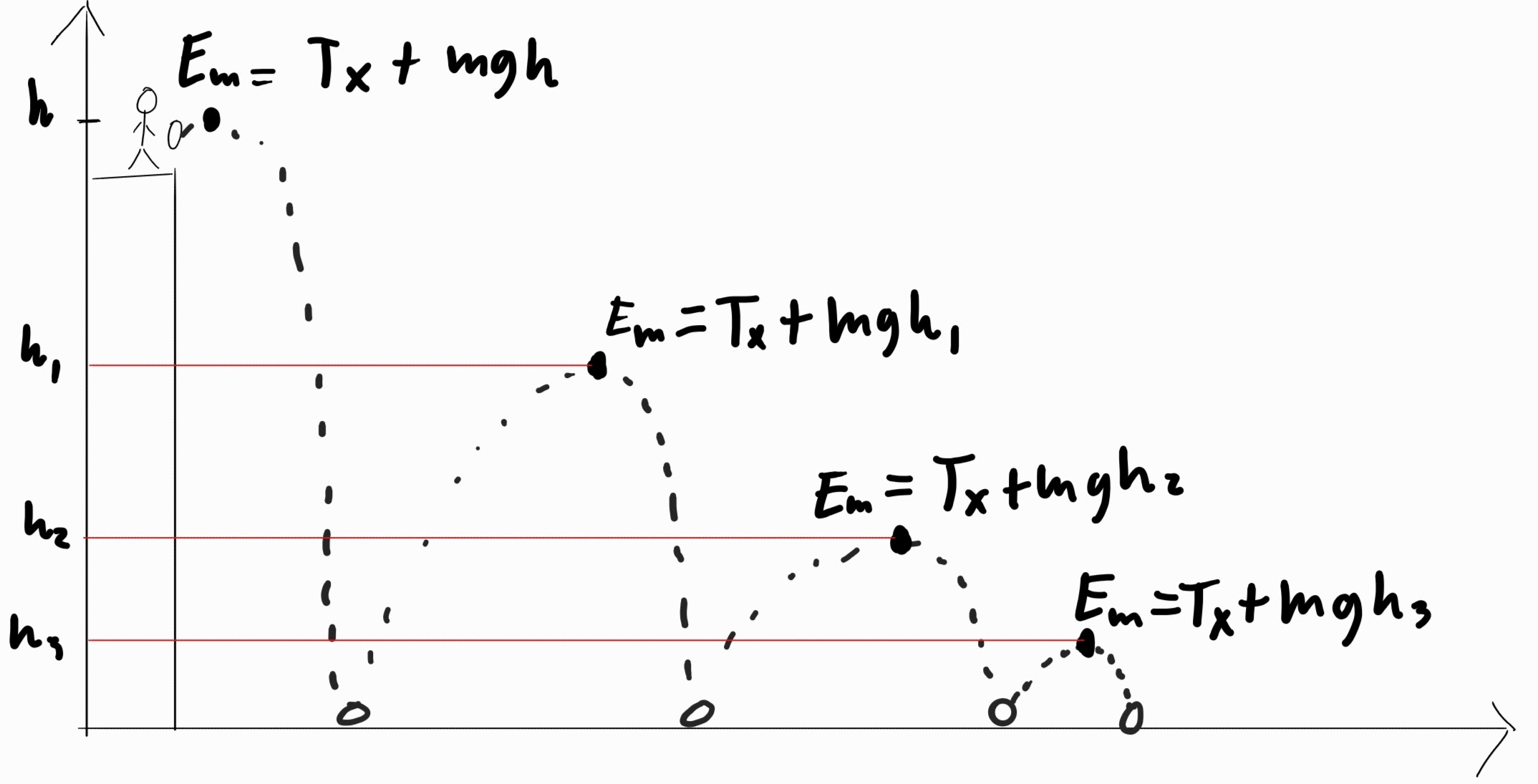
To answer this question, we must look into the different types of energy existing when a ball bounces off the ground.
In an ideal system, it should be clear that the peak of the height which the ball bounces must stay constant to ensure that energy is conserved.
This is because, when the ball drops to the bottom, by the conservation of energy we will find that
\[E=T_x+T_y=T_x+mgh\]where \(T_x\) and \(T_y\) are \(\frac{1}{2}mv_x^2\) and \(\frac{1}{2}mv_y^2\). Must stay a constant. Meaning that regardless of how many times the ball has bounced, when the ball is at it's peak height \(T_y=0\), the gravitational potential energy must be \(mgh\), indicating that the ball always bounces to the same peak height \(h\).
This is assuming that the total energy of the system is equal to what we call it's "mechanical" energy. In reality, energy comes in more than just the usual kinetic and potential energy of a moving body we expect.
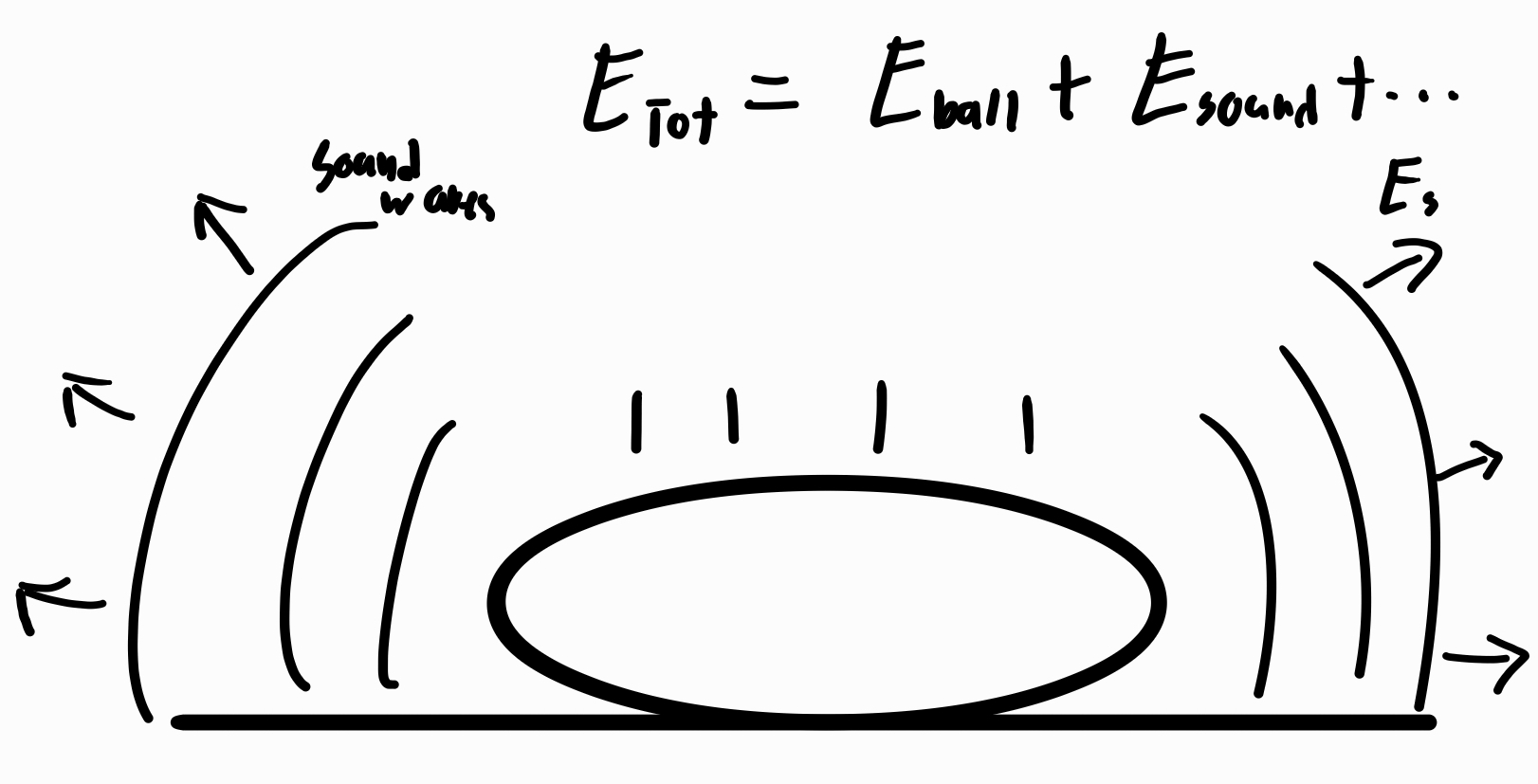
For this case, we expect the ball to make some bouncing noise, or drag a bit of air ass it falls. This does not mean that the energy is truly lost. It is merely transferred to different forms. In here, the noise the ball makes is a sound wave. This sound wave carries energy, where from? It must be from the ball's vibrations as it bounces off the ground.
Also, as the ball drags the air, we can say that all the air particles with tiny amounts of masses start moving more, therefore the energy of the ball is also transferred into the air's kinetic energy as the ball drops.
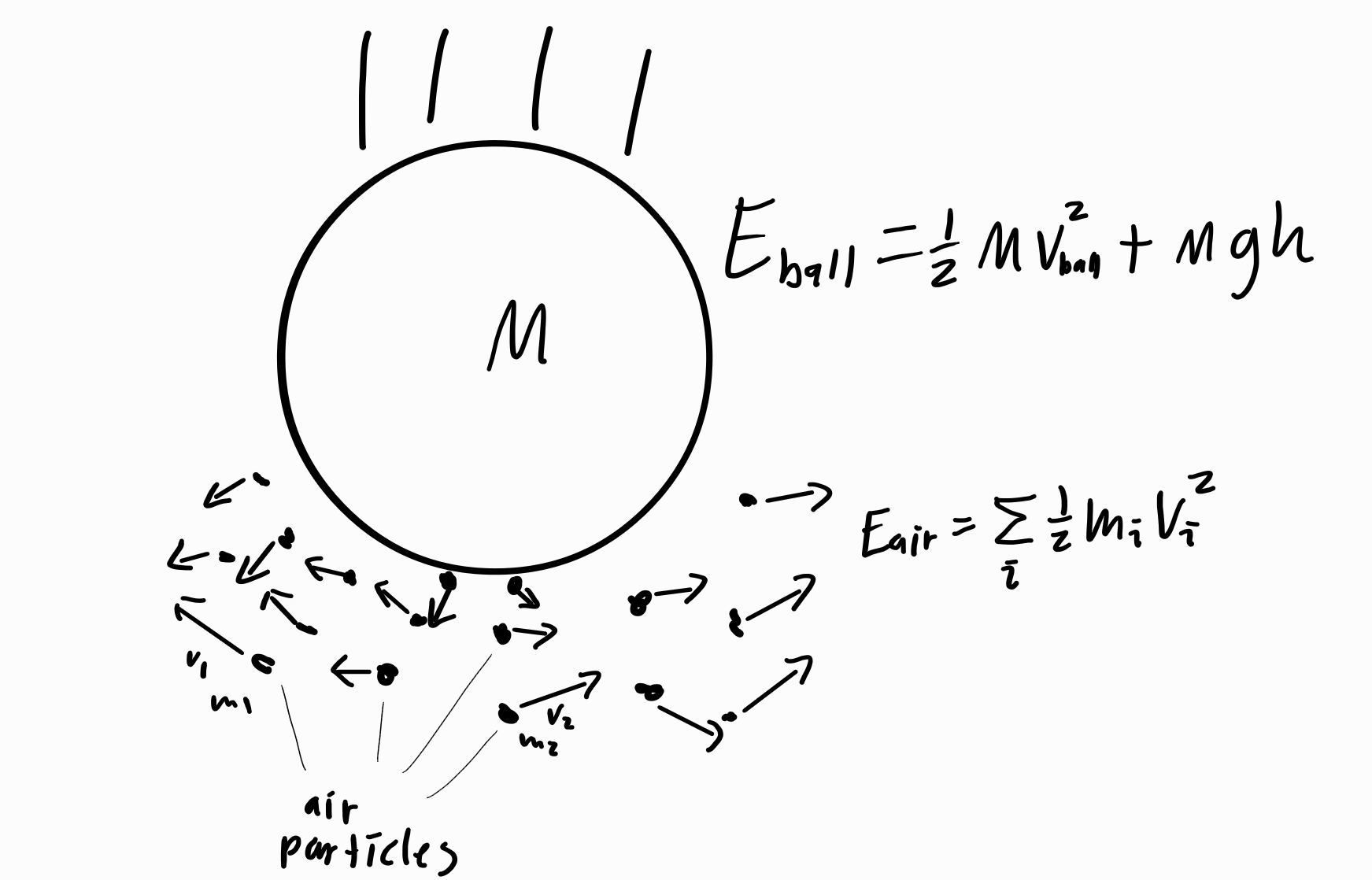
So now, if we said that the total energy of the system would equal
\[E_{tot}=E_{ball}+E_{air}+E_{sound}+...\]We can then truly say that the total energy of our sytem is conserved.
That's nice, we can see how mechanical energy can be lost and transferred into other forms of energy. But now, what if we wanted to transfer other types of energy into mechanical energy?
That is also possible! Let's try now consider how we can turn different types of energy to motion.
Elementary analysis of a Neuclear reactor (Heat energy)
Before we get into analyzing neuclear energy. We will have to understand what heat and temperature are. So let's go through a breif rundown of temperature and heat.
Rundown of heat and temperature
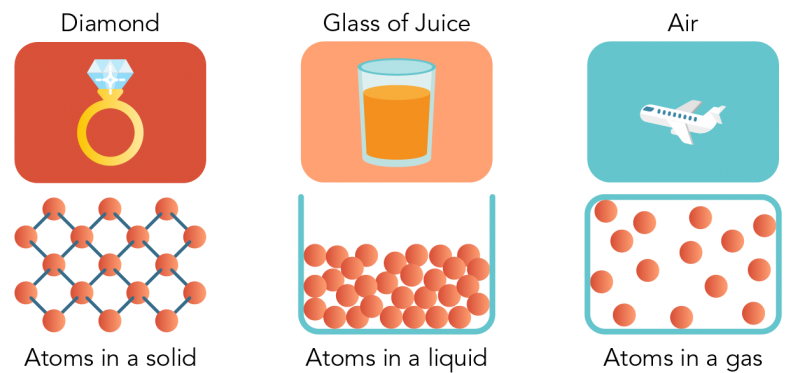
It is well known that matter in classical physics is made up of these little particles called atoms.
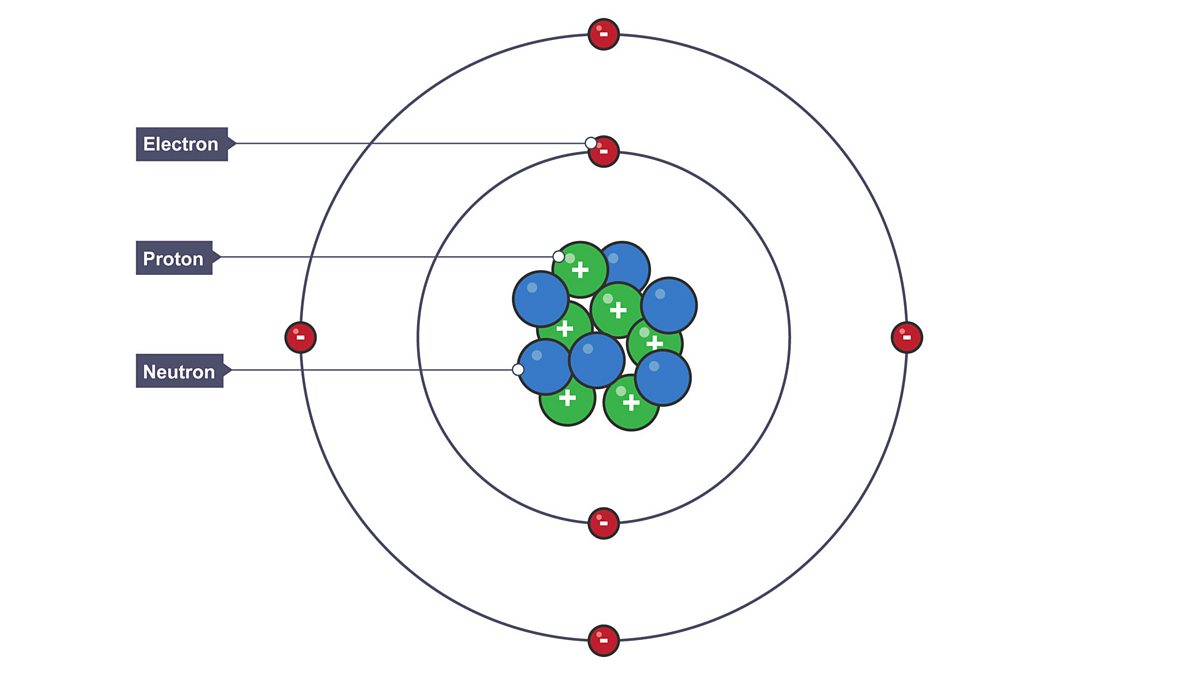
These atoms are made up of 2 components and 3 particles. In the center of the atom, there is a "Neucleus" which contains a proton and neutron. Outside of the nucleus, there are electrons surroundign the atom. Protons are positively charged, Electrons are negatively charged and Neutrons have a net \(0\) charge.
Most atoms are stable, this means that they are structured so that the forces of of all the particles in the atom balance each other out so that they tend to keep the structure.
All atoms tend to wiggle around and vibrate. Due to this, we can say that all these atoms that exist in matter have kinetic energy.
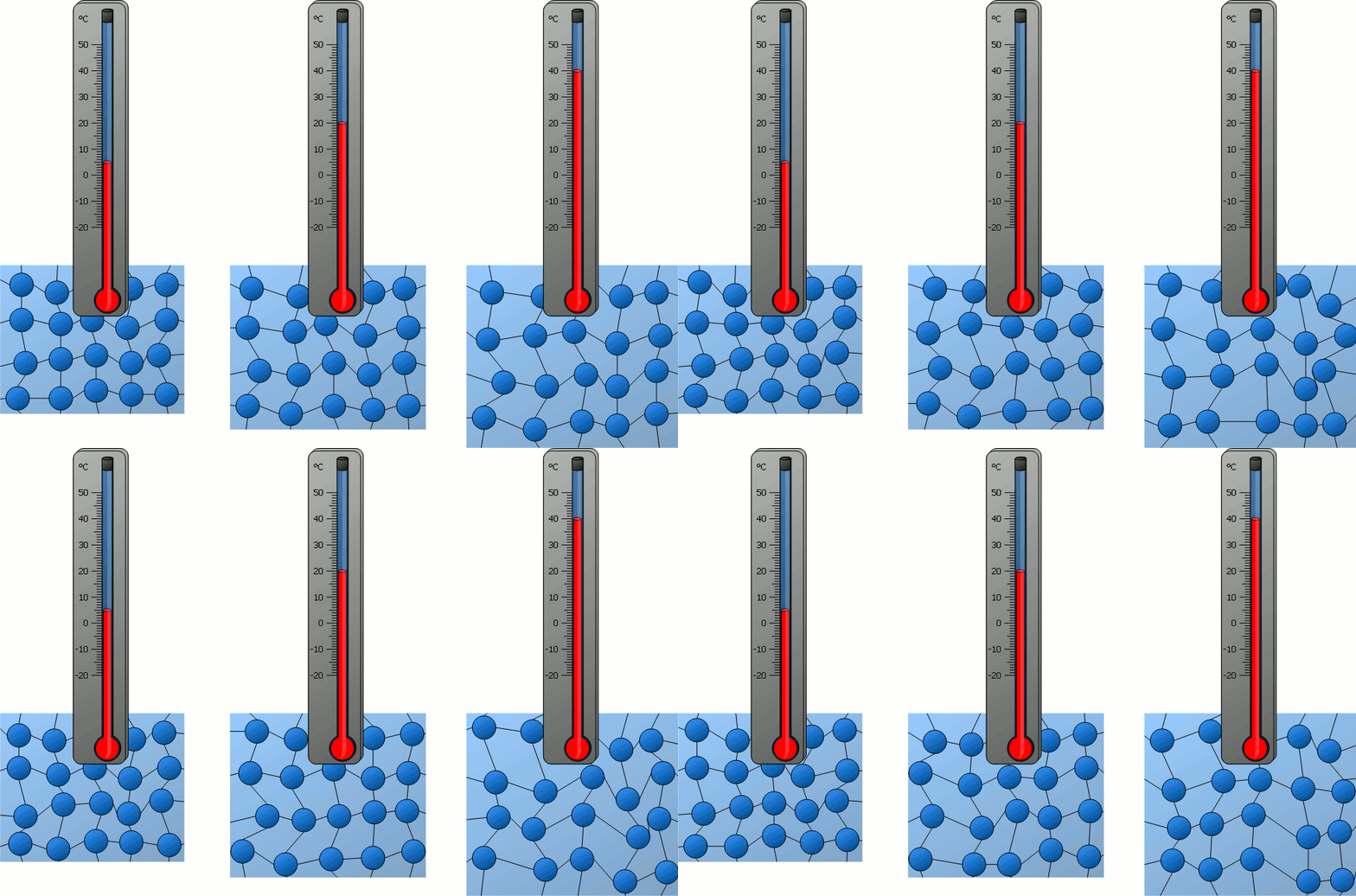
The temperature of an object is related to the kinetic energy of the atoms in an object. It can be transferred between particles by interacting with each other, whether the interaction may be "collision" or electrostatic repulsion.
The transfer of the kinetic energy in particles is what we call heat conduction.
Nuclear reactors may first sound really daunting, but it's actually less complicated than you may think it is. Let's take a dive into what's going on in a nuclear reactor and how it generates energy.
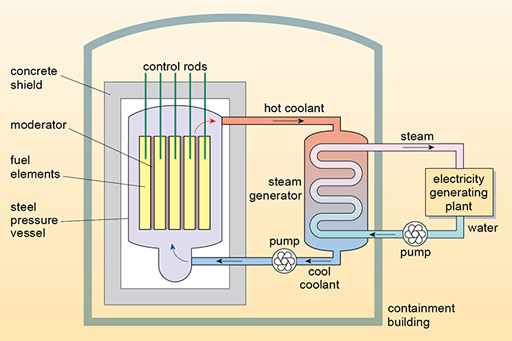
If you aren't a big fan of heavy mathematics, you're in luck here. In here I won't compute the amount of energy generated by a generator, I will only go through how it works.
Let's look at this piece by peice. We first have the fuel elements and control rods.
The fuel elements here are usually rods of unstable elements such as Uranium or Plutonium. These "unsatble" elements tend to release energy in what we call "radioactive decay" in order to go to a more stable state.
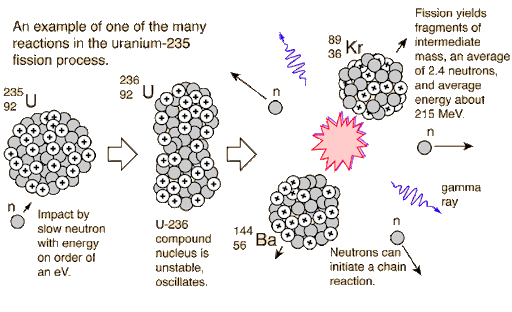
The energy which is released by the fuel elements is absorbed by the water which surrounds it. Increasing the liquid's temperature as the fast moving neutrons collide with water molecules.
We have the control rods as well to absorb some of the excess energy generated by the decay so that the energy release doesn't overload the system. This helps moderate the flow of energy in the generator.
After the liquid is heated by the Uranium rods, it is then transferred through tubes into the steam generator. This make steam as the hot pipes conducts heat to the water to create steam.
This steam has kinetic energy as it flows out of the chamber. This steam can be use to push wheels or power engines.
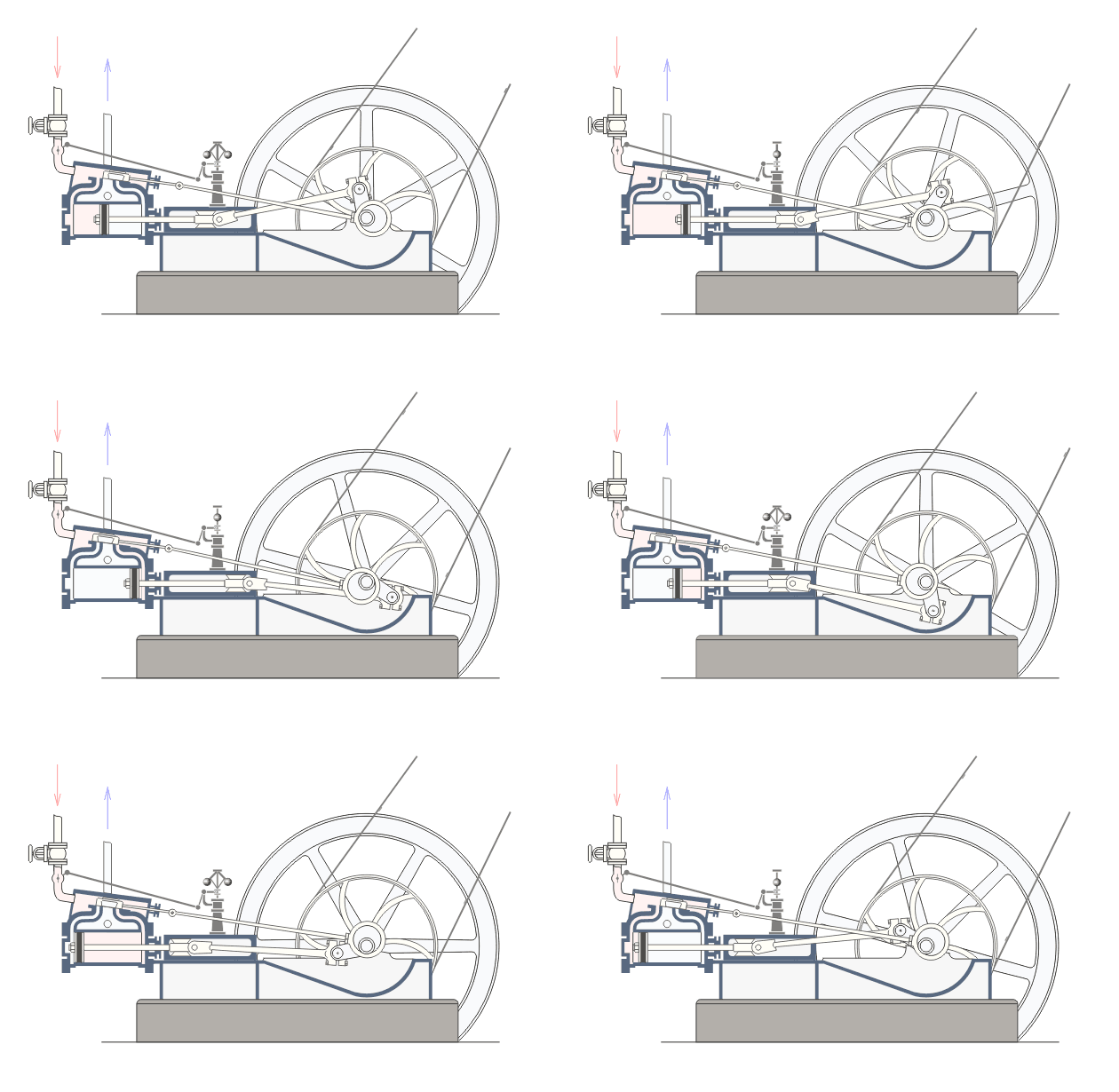
That is the jist of how a nuclear plant can generate mechanical energy simply by using the fact that some elements are unstable.
There ar emany more different types of energy we could discuss, but doing so would take a very long time ad there are multitudes of different energy types and methods of conversion.
Bottom line here is that energy cannot be created not destroyed, it can only be transferred from one medium to another.
Summary of Important Types of Energy in Physics
Energy is a fundamental physical quantity representing the ability of a system to do work or produce change. Although energy appears in many different forms, all physical processes can be described using a small set of core energy types.
Mechanical Energy
- Kinetic Energy - Energy associated with motion: \[ T = \tfrac{1}{2} m v^2 \]
- Gravitational Potential Energy - Energy due to position in a gravitational field (near Earth): \[ V = m g h \]
- Elastic Potential Energy - Energy stored in stretched or compressed objects such as springs: \[ V = \tfrac{1}{2} k x^2 \]
- Rotational Kinetic Energy - Energy of rotating bodies: \[ T_{\text{rot}} = \tfrac{1}{2} I \omega^2 \]
Thermal Energy
- Internal (Thermal) Energy - The total microscopic kinetic and potential energy of particles within a system.
- Heat - Energy transferred between systems due to a temperature difference (not a stored form of energy).
Electromagnetic and Field Energy
- Electric Potential Energy - Energy of electric charges in an electric field: \[ V_E = q\phi \]
- Magnetic Energy - Energy stored in magnetic fields.
- Electromagnetic Radiation - Energy carried by light and other electromagnetic waves: \[ E = h f \]
Chemical and Atomic Energy
- Chemical Energy - Energy stored in molecular bonds.
- Atomic Excitation Energy - Energy associated with electrons in excited atomic states.
- Ionisation Energy - Energy required to remove an electron from an atom.
Nuclear and Relativistic Energy
- Nuclear Energy - Energy stored in atomic nuclei, released in fission and fusion reactions.
- Rest Mass Energy - Energy equivalent of mass: \[ E = mc^2 \]
Key Principle: Energy is conserved. In an isolated system, the total energy remains constant, although it may be transformed from one form to another.
Wow, we've started this section on energy by understanding that energy was this abstract quantity and managed to find a new physical law called a conservation law.
We will find that this "conservation" law plays a huge part in the next section on momentum. Hope to see you there!